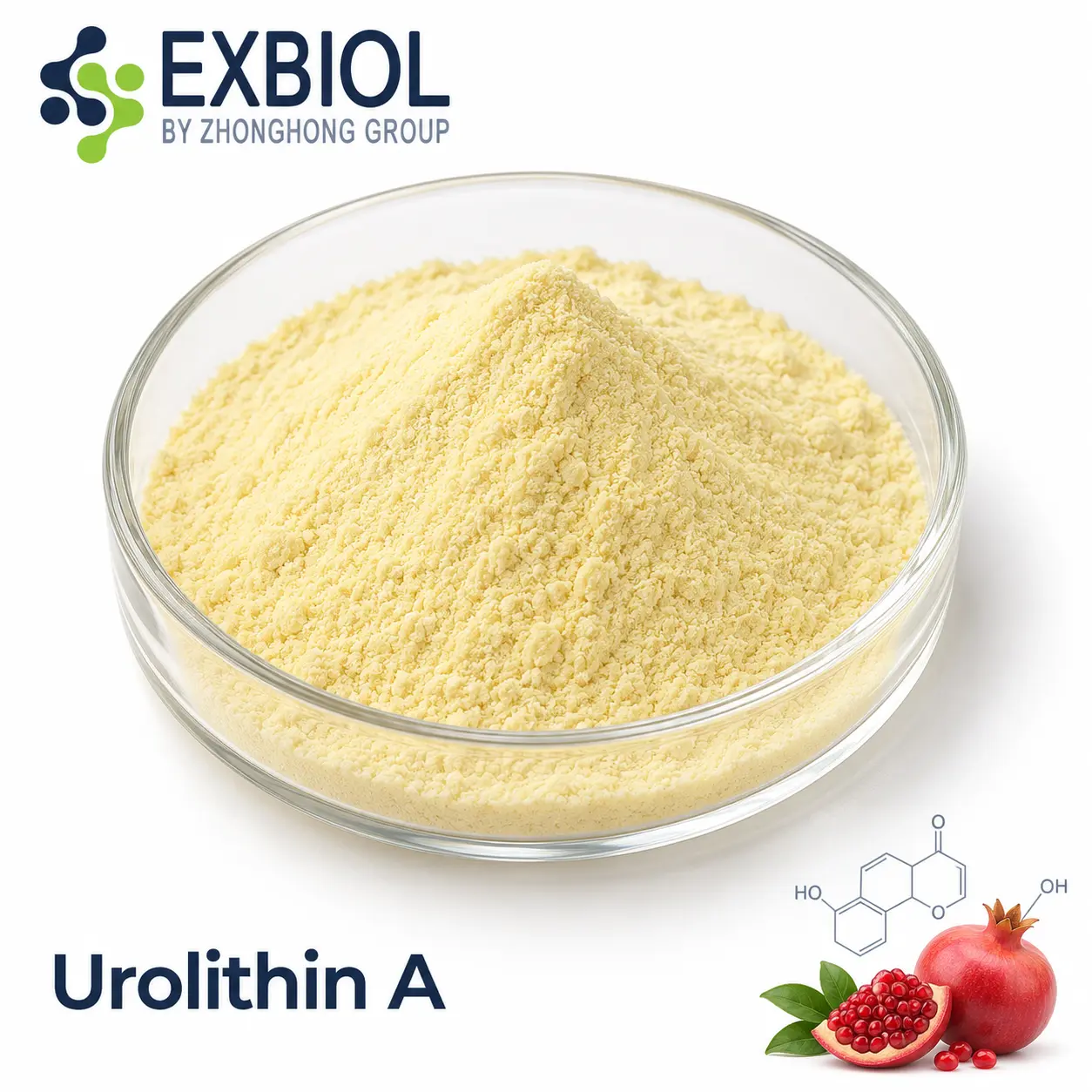


EXBIOL® supplies Urolithin A bulk powder (≥99.0% HPLC; CAS 1143-70-0) for ingredient procurement, supplement formulation, contract manufacturing and analytical R&D. For teams seeking a China-based Urolithin A supplier or a bulk raw-material purchasing option, our qualification process focuses on manufacturer and source documentation, batch COA review, HPLC assay, molecular identity, micronized particle-size requirements and quotation by confirmed supply lot.
*Micronized target and reference-lot results are grade-dependent; the currently available lot must be confirmed separately.
01. Procurement & R&D Qualification
Two types of teams evaluate Urolithin A for different reasons. EXBIOL presents the requirements separately so purchasing decisions do not substitute for analytical review.
Procurement Track
- Commercial ≥99% HPLC grade and available lot
- MOQ, packaging, production lead time and Incoterms
- COA, sample, TDS/SDS and production-origin declaration
- Supply continuity, import requirements and price tiers
R&D / QA Track
- HPLC assay, related peaks and sample-to-lot traceability
- Molecular identity and impurities, with methods
- D10/D50/D90, dispersion and blend uniformity
- Residual solvents, elemental impurities and stability evidence
First qualification action: request the current offered-lot COA and an agreed technical acceptance matrix before confirming a commercial shipment.
02. What Is Urolithin A 99% HPLC?
Urolithin A (UA; CAS 1143-70-0) is a defined small molecule also known as 3,8-dihydroxybenzo[c]chromen-6-one. It can be generated as a gut-microbial metabolite from dietary ellagitannin-related precursors, but microbial conversion differs between individuals.
The EXBIOL commercial ingredient is described as synthetically manufactured Urolithin A, not a direct pomegranate extract. An identical chemical name does not establish equivalent impurity profiles, production methods, dosage-form performance or regulatory eligibility among suppliers.
The ≥99.0% figure is a specified HPLC assay requirement. It is not a statement that the material contains zero impurities, that each lot is identical, or that an individual formulation has demonstrated clinical effects.
03. Chemical Identity & Manufacturing Source
Registry identifiers and structural formula can be independently checked against PubChem CID 5488186. A verified molecular-structure image can be added through the WordPress Media Library; no simulated HPLC chromatogram is used here.
CAS
Molecular Formula
Molecular Mass
Source
Botanical Latin name and plant part are not applicable to the supplied synthetic chemical active. A marketed formulation may refer to the molecule’s natural occurrence in metabolism, but the finished ingredient’s actual source must be stated independently.
For technical audits, request a chemical-identity statement, grade specification and process-related impurity controls. Information about synthesis routes, catalytic residues and specific manufacturing sites should be confirmed from authorized manufacturer records; it is not inferred from a marketing process diagram.
04. Technical Specification Dashboard
≥99.0%
7.42 µm
51 ppm
24 months
The following table intentionally separates the product target from the published February 2026 reference-lot results. Historical reference values are not current inventory guarantees.
| Parameter | Specification / Evidence |
|---|---|
| Urolithin A assay | ≥99.0% HPLC target; reference result 99.66% |
| Reference lot | MLP-UA-20260202 (manufacturer-issued reference COA; current lot must be confirmed) |
| Particle size | Micronized target D90 ≤10 µm; reference D90 7.42 µm |
| Water content | Reference 0.38% by Karl Fischer |
| Methanol | Reference 51 ppm by headspace GC; not methanol-free |
| Appearance | Beige to yellow fine powder (reference COA: Conforms); current-lot confirmation required |
| Carrier / excipients | Not independently established by the public batch summary; request composition declaration |
| Current shipment lot | To be confirmed with current COA and quotation |
Reported method labels and historical values must be checked against original approved COA/TDS before an official customer dossier is issued.
05. Why HPLC Purity Alone Is Not Enough
A high HPLC assay can support ingredient qualification but does not fully establish chemical identity, related-substance distribution, process residues, water content or formulation suitability. Procurement should distinguish a mass-based assay from a chromatographic peak-area percentage and verify the calculation basis.
- Identity: confirm the correct Urolithin A structure and exclude relevant alternative compounds.
- Purity: review integration, reference standards and identified/unknown secondary peaks.
- Process contaminants: examine applicable solvent and elemental limits.
- Physical grade: confirm particle size and blend behavior independently of chemical purity.
An attractive single numerical assay should not replace a lot-matched analytical package.
06. HPLC Assay & Chromatogram Review
The published reference lot lists 99.66% HPLC using method TM-C02000. Its separate chromatogram is associated with sample identifier UA-260202-A; QC must confirm the documented connection to lot MLP-UA-20260202 before the graph is represented as a matched batch report.
HPLC qualification should address the main peak, secondary peaks, assay calculation and impurity specifications. Additional impurity statements should only be released after QA reconciliation of the original instrument output and COA reporting basis.
Image placement: use an actual chromatogram image only after the underlying instrument report and sample-to-lot mapping are approved. Do not reconstruct peaks for decorative purposes.
Actual HPLC instrument record (UA-260202-A)
The supplied UV chromatogram lists a detection wavelength of 220 nm, a major peak at 10.608 min and a secondary peak at 12.632 min. The chromatogram reports 99.662% for the major peak and 0.338% for the secondary peak. These are instrument-report percentages and cannot automatically be interpreted as absolute mass assay or equivalent to the COA’s 0.04% single-impurity result.
Retention time is method-dependent. The chromatogram-to-lot mapping and assay / impurity calculation basis require QA reconciliation before an image or definitive batch-matched interpretation is published.
07. NMR, LC-MS & XRD Identity Evidence
Different analytical instruments answer different questions. They should not be presented as interchangeable proofs or as verified testing of a specific batch without traceability.
- 1H NMR: useful for structural identification with assignable resonances, a solvent record, acquisition details and traceable sample ID.
- LC-MS: can support mass-related identity review and investigation of selected related compounds when the method is appropriate.
- XRD: may be used for solid-state or crystalline-form comparisons if a validated reference and sample-specific record exist.
Documented reference COA findings: lot MLP-UA-20260202 records ¹H NMR identification: Conforms (Bruker 400 MHz) and LC-MS molecular-weight identification: Conforms (Agilent LC-MS). These are recorded COA findings. Separate raw spectra, mass data and their precise sample-to-lot attribution require controlled review before being presented as a fully batch-matched analytical dossier.
Separate solid-state product: EXBIOL Cocrysta™ (Urolithin A with levocarnitine) has its own NMR/XRD evidence. This co-crystal evidence must not be presented as the XRD result for the conventional ≥99% Urolithin A powder.
08. Reference Batch COA & Traceability
Reference only: lot MLP-UA-20260202, manufacturing date February 2, 2026; the current website lists a retest date of February 1, 2028. The underlying signed COA remains the authoritative source and should be reviewed before quotation release.
| Test | Published Reference Result |
|---|---|
| HPLC assay | 99.66% |
| D90 (laser diffraction) | 7.42 µm |
| Water content (KF) | 0.38% |
| Methanol (HS-GC) | 51 ppm |
| Lead (ICP-MS) | <0.5 ppm |
| Arsenic (ICP-MS) | <1.0 ppm; not proof of <0.5 ppm |
| Cadmium / mercury | Cd <0.5 ppm; Hg <0.1 ppm |
| Microbiology | TPC <100 cfu/g; yeast & mold <10 cfu/g |
Published statements about other solvents or negative pathogen results require the original test panel, detection limits and method before inclusion in a formal qualification certificate.
09. Micronized Particle-Size Qualification
For the micronized Urolithin A grade, the website states a target of D90 ≤10 µm; the February 2026 reference lot reports D90 7.42 µm by laser diffraction. Buyers should request the complete D10/D50/D90 distribution, sample-dispersion procedure, measurement conditions and any repeatability criteria when available.
Why it matters: smaller particles can change specific surface area, agglomeration, blend uniformity, dust behavior and dissolution kinetics under a given test condition. Micronization alone does not establish water solubility, human bioavailability or equivalence to a proprietary formulated preparation.
80 mesh is not the same specification as D90 ≤10 µm. Specify the analytical method appropriate to the actual grade rather than using the two designations interchangeably.
10. Residual Solvents, Impurities & Elemental Control
Process-related impurities depend on the production route. A proper Urolithin A supplier evaluation reviews residual solvents by headspace GC, elemental impurities by an appropriate method such as ICP-MS and chromatographic related-substance criteria.
- Methanol: the reference result is 51 ppm; do not describe this reference material as “methanol-free”.
- Other solvents: confirm the manufacturing solvent inventory, appropriate screening panel and detection/reporting limits.
- Elemental contaminants: define acceptance criteria by application and destination market; the reported arsenic result of <1.0 ppm does not prove compliance with a stricter <0.5 ppm specification.
- Related substances: review unidentified peaks and compound-specific risk rather than applying a generic “zero impurities” claim.
References such as ICH Q3C, ICH Q3D or USP <467> may inform an applicable customer specification, but their use must be justified for the material and intended finished product; citing a guideline alone does not establish compliance.
11. Solubility, Dispersion & Formulation
Urolithin A has limited aqueous solubility. A micronized powder may form a suspension or dispersion without producing a true molecular solution. Formulation compatibility depends on concentration, pH, excipients, mixing, temperature and the target dosage form.
Capsules & Tablets
Evaluate flowability, caking, excipient interaction, uniformity and compression or encapsulation performance.
Powder Blends
Assess particle-size matching, segregation, dose uniformity and moisture control.
Liquid Systems
Measure sedimentation, optical appearance, viscosity and storage behavior; clarity is not guaranteed.
Claims of defined absorption multipliers, superior stability in a particular beverage pH range or compatibility with NMN/NR combinations require separate formulation-specific data and are not made for this raw powder.
Formulation Screening Matrix
| Dosage Form | R&D Qualification Test |
|---|---|
| Hard capsules | Powder flow, tapped density, blend uniformity and fill-weight consistency; evaluate excipients only after compatibility screening |
| Compressed tablets | Compression, content uniformity, disintegration, dissolution and stability with selected fillers/binders |
| Dry powder blends | Agglomeration, segregation, dose homogeneity and moisture uptake |
| Liquid suspensions / RTD | True solubility vs dispersion, sedimentation, pH, viscosity, appearance and shelf stability |
| Encapsulated delivery systems | Screen lipid, cyclodextrin or other carrier concepts for loading, release, stability, safety and intended-market acceptance; no validated performance claimed |
Materials such as MCC, MCT, liposomes or cyclodextrins are formulation-screening possibilities, not proven EXBIOL recipes or evidence of improved human absorption.
13. Manufacturing & Supplier Qualification
Technical sourcing should follow a defined acceptance sequence: manufacturing-source identification, supplier audit documents, product standard, approved analytical methods, qualified lot, agreed transport and release criteria.
- Confirm which manufacturing site and legal entity are responsible for the offered lot.
- Review current certificates against the site, validity dates, scope and product category.
- Agree a specification covering HPLC identity/assay, impurities, solvents, metals, microbiology and particle size as appropriate.
- Review the actual batch COA and document sample-to-lot linkage for supporting NMR/LC-MS/XRD files.
- Approve pre-shipment sample, packaging and quality agreement as needed.
EXBIOL’s analytical qualification approach does not imply that every instrument is used on every batch, or that Urolithin A automatically holds an API, pharmacopeial or clinical-grade designation.
14. Packaging, Storage & Retest Management
Protect Urolithin A powder in sealed, moisture-resistant packaging, away from inappropriate heat, direct sunlight and avoidable contamination. The final storage conditions must match the approved grade-specific TDS, not generic marketing text.
Potential pack formats include foil bags and lined bulk drums, but actual fill weight, liner materials, palletization and shipping configuration require quotation confirmation. The published February 2026 reference lot lists February 1, 2028 as its retest date. Do not automatically replace that date with a projected 36-month expiration.
For long-distance shipping, purchasers may request pack-integrity expectations, temperature excursions review and handling instructions as appropriate for their destination and climate.
15. Clinical Research & Evidence Boundaries
Urolithin A has been researched in relation to mitophagy, mitochondrial quality control and aspects of muscle function. Such studies provide scientific context, not a clinical certification of EXBIOL’s raw-material batches.
In a randomized clinical study of 66 older adults published in JAMA Network Open in 2022, selected secondary muscle-endurance outcomes and biomarkers improved, while important primary endpoints did not show statistically significant treatment differences. Results must be interpreted by study population, intervention, duration and endpoint, without extending them automatically to another ingredient or finished formula.
Read the 2022 randomized clinical trial. Product claims, dosage design and clinical substantiation should be reviewed separately by the customer’s regulatory and scientific teams.
Research Context: Mitophagy Mechanism Overview
01 | Signaling
Published studies investigate mitochondrial stress and cellular quality-control signaling.
02 | Mitophagy
Mechanistic research explores the selective removal of damaged mitochondria.
03 | Human Outcomes
Clinical relevance depends on the tested preparation, population, endpoints and study quality.
Illustrative research pathway, not batch-specific mechanism validation or a guaranteed claim about muscle growth, mitochondrial biogenesis or clinical benefit from EXBIOL raw material.
16. Regulatory Status & Market Access
Urolithin A’s legal status cannot be inferred from its CAS number, chemical similarity, high purity or another company’s regulatory dossier. The destination, intended use, manufacturing route and supplier-specific identity are material.
United States: FDA’s GRAS Notice GRN 000791 concerns a specific preparation and intended food uses described by Amazentis SA. FDA issued a no questions response regarding the notifier’s conclusion under those stated conditions. This does not constitute blanket FDA approval of EXBIOL material, every dietary supplement use or every production route.
Other markets: European Union, United Kingdom, Canada and other jurisdictions may require separate food/novel-food, supplement, labeling or other market-access review. No universal authorization is claimed here. Buyers should review relevant patents and freedom-to-operate questions with qualified legal counsel before commercialization.
FDA response letter — GRN 000791.
Market-Access Qualification Checklist
| Topic | Technical / Regulatory Action |
|---|---|
| U.S. GRAS / NDI | Review intended use, production identity, and applicability of public notices; GRN 791 is not a blanket EXBIOL authorization |
| EU / UK market | Check current novel-food / supplement rules and the exact ingredient’s legal eligibility before sale |
| Customs classification | Confirm destination-specific tariff classification with a customs specialist; no unverified HS code is declared |
| Quality & IP review | Current-lot documents, intended grade, regulatory restrictions and counsel-led freedom-to-operate review |
17. Applications & Target Buyer Scenarios
EXBIOL’s Urolithin A raw-material sourcing program is relevant to the following technical evaluation projects, subject to each market’s applicable rules:
- Supplement brands and contract manufacturers: capsule/tablet formulation work, dose uniformity and ingredient qualification.
- Healthy-aging product R&D: scientific literature evaluation and formulation feasibility, without automatic consumer benefit claims.
- Ingredient distributors: specification harmonization, COA traceability, packaging and supply agreements.
- Analytical and biotechnology laboratories: suitable-grade evaluation for identity/purity projects, with required methods and standards agreed in advance.
- Advanced powder-formulation teams: comparative evaluation of standard and micronized PSDs in the target manufacturing matrix.
For project-specific support, visit EXBIOL Longevity & Nootropic Ingredient Solutions and Technical Dossiers.
18. Supplier Comparison & Bulk Procurement
For a fair Urolithin A manufacturer and bulk supplier comparison, assess documented criteria rather than unsupported claims about another company’s grade or ready inventory.
| Buyer Check | Evidence Requested |
|---|---|
| Purity and chemical identity | Lot COA, HPLC method, matched identity records |
| Micronized performance | D10/D50/D90 report and formulation sample |
| Solvents and impurities | Analyte list, GC/ICP-MS results, agreed acceptance limits |
| Stability | Observed study data, shelf-life projection basis, current lot retest date |
| Commercial terms | MOQ, offered lot, packaging, lead time, freight and Incoterm |
Provide the requested quantity (sample, trial or bulk), destination country, particle-size target, documentation requirements and preferred delivery basis when asking for wholesale pricing. Price, available inventory, MOQ and lead time are confirmed by individual quotation.
Bulk purchase options for procurement teams
EXBIOL supports inquiries for Urolithin A bulk powder, evaluation quantities and commercial raw-material orders. Request a quote with your target HPLC specification, required quantity, particle-size target, supporting analytical documents, destination and Incoterm. Current MOQ, available batch, volume price and lead time are confirmed individually rather than guaranteed from an older reference COA.
19. Frequently Asked Technical Questions
These answers address sourcing, analytical qualification and formulation questions. Customer-specific requirements should be confirmed against the proposed lot and current commercial terms.
Are there bulk purchase options for Urolithin A powder?
Is ≥99% HPLC purity a peak-area percentage or absolute assay?
Do you have NMR, LC-MS and XRD evidence?
Can Urolithin A powder be used in a liquid beverage?
Can you provide independent ISO 17025, SGS or Eurofins test reports?
Can I request a 20–100 g sample and 1 kg or 25 kg supply?
What packaging, Incoterms and delivery options are supported?
Is a 36-month shelf life demonstrated?
Is Urolithin A FDA-approved for every supplement application?
These expandable questions improve on-page readability. No FAQPage markup is included or implied to produce a Google FAQ rich result.
20. References, Technical Resources & Final CTA
Scientific and regulatory sources: Liu et al., JAMA Network Open (2022); FDA GRAS Notice 791 response letter.
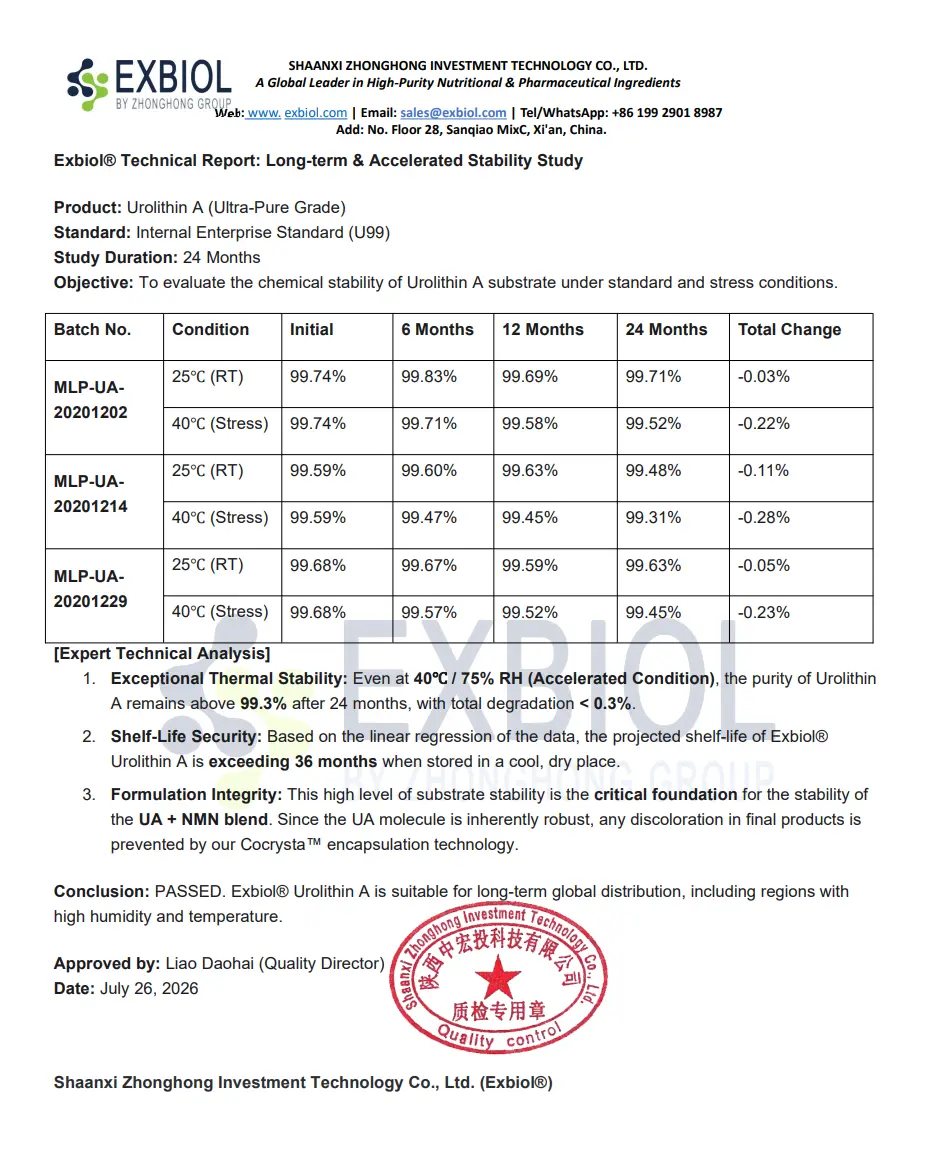
EXBIOL internal reference: Technical Report: Long-term & Accelerated Stability Study — Urolithin A U99, July 26, 2026. This company document summarizes three 2020 historical lots and is not a substitute for original signed analytical data or an independently audited expiry assignment.
Related EXBIOL pages: High-Potency Active Ingredients • Longevity Ingredient Solutions • Technical Dossiers.
Request the current offered-lot COA, verified particle-size data, source declaration and project-specific commercial terms. Tell us your target specification, expected quantity and destination.
EXBIOL® supplies B2B ingredient documentation and sourcing support. Product-specific evidence, commercial availability, intended-use suitability and local regulatory requirements must be verified before purchase and commercialization. No disease-treatment or guaranteed human-performance claims are made.