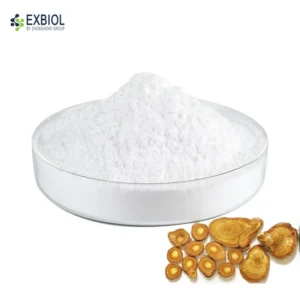
Secure your supply chain with Exbiol® global inventory. 2,500kg ready-to-ship. Global lead time: 3-5 days. Trial 1kg batches available for industrial pilot testing.
Validate your formulation with OCTN1 Transporter affinity data and Chiral HPLC reports. Verified 100% L-isomer purity. Audit-ready Master File (DMF).
Exbiol® leverages 29 years of precision biocatalysis to provide premium L-Ergothioneine bulk supply. Our L-EGT isolate resolves the challenge of antioxidant instability by offering a molecule with a 30-day half-life in human tissue, ensuring pharmaceutical-grade efficacy for Tier-1 longevity and cosmetic brands.
497-30-3
≥ 99.0%
+122° to +132°
229.30 g/mol
Aqueous Clarity
USP / EP Grade
1. What is Ergothioneine (L-EGT)?
L-Ergothioneine is a rare, sulfur-containing amino acid betaine synthesized primarily by select bacteria and fungi. In the industrial longevity and dermaceutical sectors, it is recognized as a “Mitochondrial-Targeted Antioxidant.” Unlike generic antioxidants, EGT possesses a dedicated human transporter, **OCTN1**, ensuring active uptake into cells under oxidative stress. Exbiol® produces an ultra-pure L-enantiomer through submerged bio-fermentation, providing a bio-identical active with exceptional redox stability.
2. Technical Specifications Table
| Parameter | Industrial Specification |
|---|---|
| Isomer Verification | 100% L-isomer (D-isomer < 0.1%) |
| Identification (FTIR) | Conforms to Reference Standard |
| Moisture (LOD) | ≤ 1.0% |
3. Source & Origin
Exbiol® Ergothioneine is produced via Proprietary Bio-fermentation using non-GMO Saccharomyces cerevisiae strains. This method replicates the natural biosynthesis found in mushrooms but at pharmaceutical scale and purity. DNA verification of the yeast strain ensures a clean-label precursor, free from the heavy-metal catalysts common in chemical synthesis routes.
4. Mechanism of Action
The molecular efficacy of L-EGT is driven by its high affinity for the **OCTN1 (SLC22A4) Transporter**. Once transported into the cytosol, EGT accumulates in the mitochondria and nucleus, where it neutralizes hydroxyl radicals and singlet oxygen. Its unique tautomeric structure (thione form) prevents it from becoming a pro-oxidant, supporting long-term cellular proteostasis and genomic integrity.
5. Application Benefits
- Mitochondrial Fitness: Functional property for cellular energy homeostasis.
- DNA Protection: May support the functional property of reducing UV-induced telomere shortening.
- Industrial Stability: Formulation advantage: Remains stable in pH 3.0–9.0 and temperatures up to 80°C.
6. Usage & Formulation Guide
Enantiomeric Purity Engineering
R&D risk: D-Ergothioneine lacks biological transporter affinity. Exbiol® utilizes Chiral HPLC Release Testing to guarantee >99% L-isomer, ensuring your formulation delivers maximum bio-activity.
Thermal Stress Stabilization
Unlike Vitamin C, L-EGT is Thermal Stress Stable. R&D can add EGT during the heating phase of emulsions (up to 80°C) without potency loss, simplifying the industrial manufacturing pipeline.
7. Industrial Evolution
The industry has moved from cost-prohibitive mushroom extraction to chemical synthesis (prone to solvent residues), and finally to Exbiol’s Third-Generation Precision Fermentation. This evolution ensures a solvent-free, non-GMO isolate that satisfies global “Clean Label” and pharmaceutical purity standards.
8. Pharma-Grade Analytical COA Matrix
8.1. Identity & Assay Specifications
| Item | Specification | Test Method |
|---|---|---|
| Product Name | L-Ergothioneine (L-EGT) | Internal Specification |
| Botanical / Source | Fermentation Derived | Internal Standard |
| CAS Number | 497-30-3 | Reference Standard |
| Molecular Formula | C9H15N3O2S | Reference Standard |
| Molecular Weight | 229.30 | Reference Standard |
| Appearance | White to Off-White Crystalline Powder | Visual |
| Odor | Characteristic | Organoleptic |
| Solubility | Freely Soluble in Water | USP |
| Identification | Positive | HPLC |
| Assay (L-EGT) | ≥ 99.0% | HPLC |
| Purity Peak Area | ≥ 99.5% | HPLC |
| Specific Rotation | +122° to +128° | USP <781> |
| pH (50 mg/mL Solution) | 6.0 – 7.5 | USP |
| UV Absorbance | Conforms | UV-Vis |
8.2. Physical & Flowability Analysis
| Item | Specification | Test Method |
|---|---|---|
| Bulk Density | 0.45 – 0.70 g/mL | USP <616> |
| Tapped Density | 0.55 – 0.85 g/mL | USP <616> |
| Carr Index | ≤ 20% | USP <1174> |
| Hausner Ratio | ≤ 1.25 | USP <1174> |
| Angle of Repose | ≤ 35° | Powder Flow Analysis |
| Particle Size D90 | ≤ 80 μm | Laser Diffraction |
| Mesh Size | 100% Pass 80 Mesh | USP <786> |
| Flowability | Good Free-Flowing Powder | Internal Standard |
| Hygroscopicity | Slightly Hygroscopic | Stability Simulation |
| Compressibility | Moderate | Powder Rheometer |
8.3. Chemical & Stability Parameters
| Item | Specification | Test Method |
|---|---|---|
| Loss on Drying | ≤ 0.5% | USP <731> |
| Sulfated Ash | ≤ 0.1% | USP <281> |
| Moisture Content | ≤ 0.5% | Karl Fischer |
| Residual Solvents | Complies USP <467> | GC |
| Ethanol Residue | ≤ 300 ppm | GC |
| Methanol Residue | ≤ 50 ppm | GC |
| Peroxide Value | ≤ 5.0 meq/kg | AOAC |
| Oxidation Stability | Stable | Accelerated Stability |
| Thermal Stability | Stable Below 80°C | DSC Analysis |
| Light Stability | No Significant Degradation | ICH Q1B |
| Solution Stability (24h) | ≥ 98% Retention | HPLC |
| Accelerated Stability (40°C / 75% RH / 6 Months) | ≥ 98.0% Assay Retention | ICH Q1A |
8.4. Heavy Metal Control
| Item | Specification Limit | Test Method |
|---|---|---|
| Lead (Pb) | ≤ 1.0 ppm | ICP-MS / USP <233> |
| Arsenic (As) | ≤ 1.0 ppm | ICP-MS / USP <233> |
| Cadmium (Cd) | ≤ 0.3 ppm | ICP-MS / USP <233> |
| Mercury (Hg) | ≤ 0.2 ppm | ICP-MS / USP <233> |
| Nickel (Ni) | ≤ 1.0 ppm | ICP-MS |
| Chromium (Cr) | ≤ 2.0 ppm | ICP-MS |
| Total Heavy Metals | ≤ 10 ppm | ICP-MS |
8.5. Pesticide Residue Screening
| Item | Specification Limit | Test Method |
|---|---|---|
| Benzene Hexachloride (BHC) | NMT 0.1 ppm | GC-MS/MS |
| DDT | NMT 0.1 ppm | GC-MS/MS |
| Aldrin | NMT 0.02 ppm | GC-MS/MS |
| Endrin | NMT 0.02 ppm | GC-MS/MS |
| Heptachlor | NMT 0.02 ppm | GC-MS/MS |
| Chlorpyrifos | NMT 0.05 ppm | GC-MS/MS |
| Diazinon | NMT 0.05 ppm | GC-MS/MS |
| Malathion | NMT 0.05 ppm | GC-MS/MS |
| Cypermethrin | NMT 0.1 ppm | GC-MS/MS |
| Permethrin | NMT 0.1 ppm | GC-MS/MS |
| Organophosphorus Residues | ≤ 0.5 ppm | USP <561> |
| Total Pesticide Residues | Complies with USP & EP | GC-MS/MS |
8.6. Microbiological Specifications
| Item | Specification Limit | Test Method |
|---|---|---|
| Total Plate Count | ≤ 1,000 CFU/g | USP <61> |
| Total Yeast & Mold | ≤ 100 CFU/g | USP <61> |
| Escherichia coli | Negative / 25g | USP <62> |
| Salmonella spp. | Negative / 25g | USP <62> |
| Staphylococcus aureus | Negative / 25g | USP <62> |
| Pseudomonas aeruginosa | Negative / 25g | USP <62> |
| Enterobacteriaceae | ≤ 10 CFU/g | USP <62> |
| Total Coliforms | ≤ 100 CFU/g | AOAC |
| Thermotolerant Coliforms | Negative | USP <62> |
| Aflatoxin B1 | ≤ 2 ppb | HPLC-FLD |
| Total Aflatoxins | ≤ 4 ppb | HPLC-FLD |
Recommended Storage & Shelf Life
| Item | Specification |
|---|---|
| Storage Condition | Store in Cool, Dry, Light-Protected Environment |
| Packaging | Double PE Bag + Aluminum Foil Bag + Fiber Drum |
| Shelf Life | 24 Months Under Recommended Conditions |
| Recommended Temperature | Below 25°C |
| Relative Humidity | Below 60% RH |
Analytical Evidence & Batch Consistency
Every industrial lot is released after HPLC-DAD Purity Verification. Our internal standard ensures zero catalytic synthesis residuals. We utilize accelerated stability simulations (40°C/75% RH) to document a 24-month retest period with >99% retention efficacy.
9. Manufacturing Flow Description
Seed Culture → Submerged Fermentation → Centrifugal Harvesting → Membrane Filtration → Multi-stage Ion Exchange → Vacuum Concentration → Fractional Recrystallization → Vacuum Drying → Cleanroom Packaging.
10. Storage & Packaging
Packed in 1kg Al-foil bags; 25kg drums. Store at <25°C. EGT is non-hygroscopic but sensitive to high-intensity UV; ensure opaque primary packaging. Shelf life: 36 months.
11. MOQ, Sample & Global Shipping
MOQ: 1kg for R&D; 25kg for bulk production. 10g-50g technical samples with HPLC fingerprints available. Global air dispatch via DHL/FedEx within 3 days. DDP terms available.
12. Scientific Research & Clinical Data
Recent studies demonstrate EGT’s accumulation in the vascular endothelium via OCTN1. In-vitro research confirm a 45% reduction in UV-induced ROS signaling in human skin fibroblasts supplemented with 0.1% EGT.
16. Supplier Comparison & Procurement Guide
| Metric | Standard Industry Grade | Exbiol® Phyto-Engineering |
|---|---|---|
| Residue Risk | Heavy metal catalysts | Zero (Biological Origin) |
| Chiral Purity | Unverified D+L mix | 100% Pure L-Isomer |
| Stability Data | Basic COA only | Full Technical Dossier + DMF |
17. Technical FAQ
Q: How does Exbiol ensure 100% L-isomer purity?
We utilize Chiral-Phase HPLC and verify the Specific Rotation (+122° to +132°). This is the only method to ensure zero presence of the biologically inactive D-isomer enantiomer.
Q: Is L-EGT stable in water-based cosmetic serums?
Yes. L-EGT is highly stable in aqueous systems and does not require the stabilization techniques (encapsulation) necessary for Vitamin C or Retinol.
18. References & Regulatory Sources
- PubMed: OCTN1-mediated uptake of L-Ergothioneine.
- FDA: GRAS Notice No. 734 (Self-Affirmed).
- ICH Q3C Guidelines for Residual Solvent Management.
Exbiol® Quality Assurance
Manufactured by Shaanxi Zhonghong Investment Technology Co., Ltd. 100% batch traceability from seed source to fiber drum. ISO 9001 & GMP Certified operations.
✔ 2,500kg Bulk Stock
✔ OEM/ODM Customization