EXBIOL® supports B2B sourcing and analytical qualification of Copper Tripeptide-1 (GHK-Cu; CAS 89030-95-5) for cosmetic formulation R&D and commercial ingredient evaluation. A ≥98% purity grade is currently a buyer target for verification, not a confirmed EXBIOL batch-release specification. Our technical review covers copper-complex identity, peptide assay methodology, elemental copper content, counterions, formulation compatibility and project-specific bulk supply conditions.
01. B2B Copper Tripeptide-1 Procurement & R&D Overview
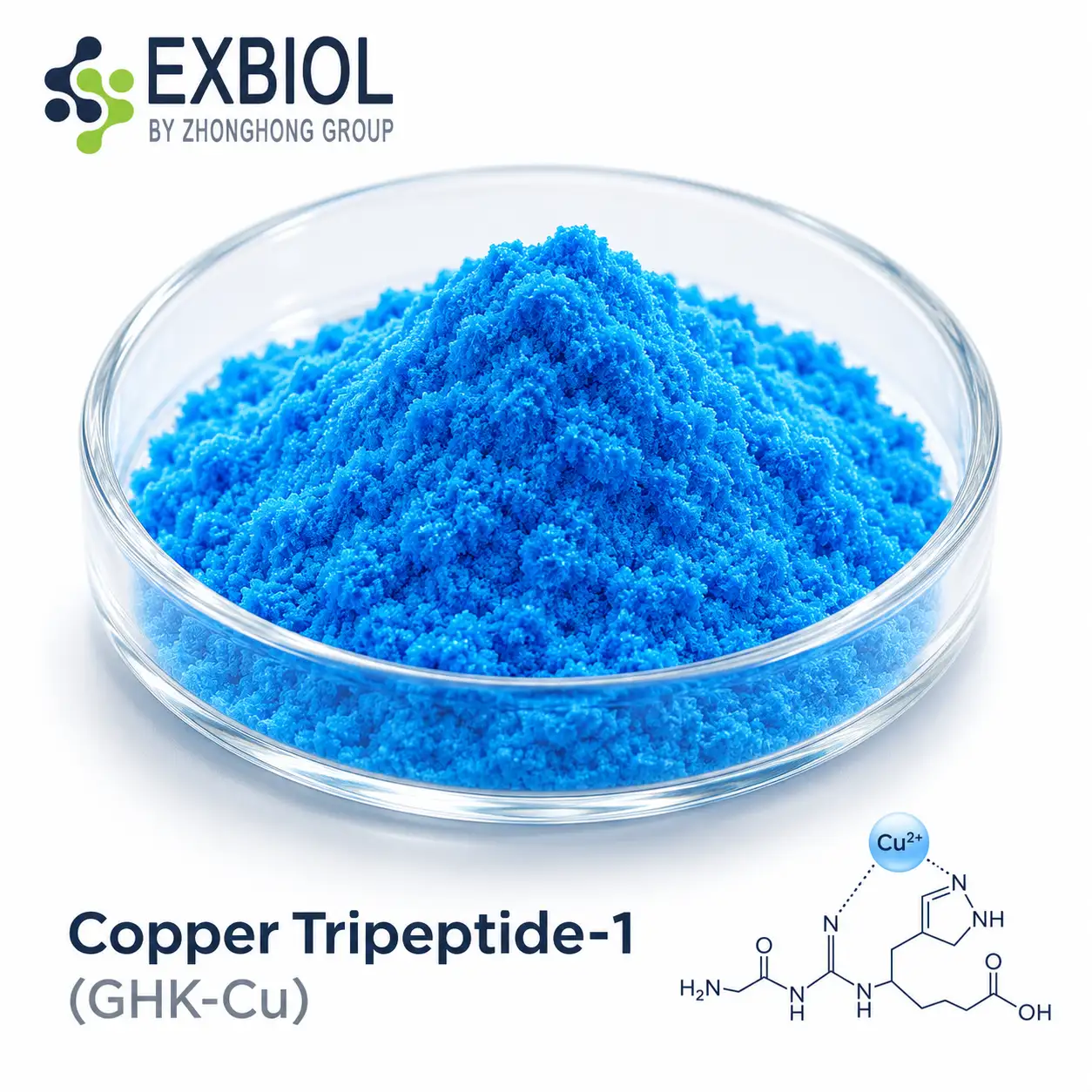
Copper Tripeptide-1 is also known as GHK-Cu, a coordination complex of the tripeptide glycyl-L-histidyl-L-lysine (GHK) with copper. Buyers seeking cosmetic peptide ingredients need more than a headline purity claim: the chemical form, assay basis, copper coordination and actual lot documentation determine whether a candidate is suitable for qualification.
02. Chemical Identity, INCI & CAS 89030-95-5
The cosmetic ingredient name is COPPER TRIPEPTIDE-1. The associated GHK tripeptide contains glycine, histidine and lysine. Metal complexation changes the chemical species compared with the uncomplexed peptide, so product identity should be defined by more than the peptide sequence alone.
03. Target Purity vs. Verified Commercial Grade
The EXBIOL directory currently lists ≥98% as a target grade subject to verification. That is a sourcing objective, not an independently audited current-batch assay. Before publication of a confirmed high-purity specification, the supplier must identify the measured analyte, assay calculation basis and supporting sample-to-lot traceability.
| Evidence level | What it means | GHK-Cu status |
|---|---|---|
| Target grade | A buyer or catalog objective for screening | ≥98% proposed; subject to verification |
| Product specification | An approved release criterion with defined analytical method | Not supplied for this project |
| Reference lot result | An actual test result tied to one lot | Not supplied for this project |
| Current supply lot | The material proposed for a new shipment | To be confirmed before quotation/release |
04. Technical Specification Qualification Matrix
Use the matrix below as a requirements checklist rather than a fabricated COA. Each release value should ultimately come from an approved product TDS and a corresponding batch COA.
| Parameter | Proposed qualification review | Release evidence |
|---|---|---|
| Identity | GHK sequence and copper-complex form | Suitable identity report with sample reference |
| Assay / purity | Specify whether copper complex, peptide, or chromatographic area percentage | Method, reference standard, calculation, approved specification |
| Copper content | Total copper and, where relevant, free copper | Appropriate elemental/speciation method |
| Counterion / salts | Specify acetate, chloride or other relevant constituents where present | Composition declaration and test scope |
| Appearance | Color, state and hygroscopicity | Actual lot inspection |
| Moisture | Method and limit to be agreed | KF or LOD as appropriate |
| Residual solvents | Relevant process solvent panel | Batch report with limits / LOD |
| Microbiology | Limits based on intended use | Microbial test report |
| Solubility & pH | Concentration and matrix dependent | Formulation evaluation |
| Packaging | Moisture/light protection requirement | Packing specification for confirmed lot |
05. Why Copper Complexation Matters More Than the Peptide Name
GHK and GHK-Cu are not interchangeable raw materials. A certificate that establishes only the presence of the tripeptide sequence does not by itself demonstrate copper coordination, the copper-to-peptide relationship or the amounts of uncomplexed peptide and free copper in a specific batch.
- GHK peptide identity: confirm the sequence and expected peptide-related mass signal.
- Copper-complex identity: define the intended complex and supporting method.
- Copper speciation: distinguish total elemental copper from free copper where clinically or formulation relevant.
- Impurity profile: review closely related peptides, salts, counterions and process residues as applicable.
06. HPLC Purity: Peak Area, Assay & Reference Standards
A high HPLC peak-area percentage does not automatically establish a ≥98% mass assay for the copper complex. Different detection systems and sample preparations may observe peptide-related species differently, and coordination conditions can affect the measured chromatographic profile. EXBIOL recommends agreeing the exact analyte, calibration and reporting basis before interpreting a purity number.
| Question for QA | Why the buyer should ask |
|---|---|
| Is ≥98% an HPLC area percentage or a quantitative assay? | The two quantities should not be conflated. |
| Is the reference standard GHK or a defined GHK-Cu material? | The standard determines what is calibrated. |
| What wavelength/detector and sample conditions are used? | The result depends on the method and species measured. |
| Are related peptide peaks and copper species separately assessed? | A single HPLC number may omit relevant qualification attributes. |
07. LC-MS, Peptide Identity & Molecular Confirmation
LC-MS may support confirmation of the peptide-related mass and investigation of certain impurity or complex species when the analytical approach is appropriate. It is not a substitute for a full chemical-composition declaration or a copper-specific result. Isotopic patterns, acquisition conditions and sample preparation should be reviewed if complex identity is a qualification priority.
08. Total Copper, Free Copper & Stoichiometry Review
For copper peptides, total elemental copper can be quantified by a suitable elemental method, while free copper and coordinated species require additional method selection and validation. Buyers should define whether they need total Cu, free Cu, copper-to-peptide ratio or a particular coordination form, and should avoid treating any one result as a proxy for the others.
| Analytical target | Possible analytical approach | Interpretation limit |
|---|---|---|
| Total copper | Validated ICP-MS / ICP-OES / other appropriate method | Does not on its own establish complex identity |
| GHK peptide | Suitable chromatography or MS method | Does not prove copper complex formation |
| Free copper / species | Fit-for-purpose selective method | Requires method verification for intended matrix |
| Counterions / salts | Composition and relevant chemical tests | Depends on actual manufacturing form |
09. Counterions, Residual Solvents & Relevant Impurities
The purchased material may be described as a copper peptide while containing counterions, hydration water or processing residues. Formulators need a truthful complete-ingredient specification, particularly when comparing suppliers or targeting sensitive finished-product matrices.
- Confirm whether the offered product contains acetate, chloride or another counterion.
- Ask whether purity is reported on as-is, dried or anhydrous basis.
- Specify process-relevant residual solvents and their limits based on the actual route.
- Request suitable elemental, microbial and related-peptide controls for the intended market.
10. Appearance, Physical Form & Powder Handling
The observed color and physical form of a copper-complex material are batch- and composition-dependent; they should be copied from the approved commercial COA, not inferred from marketing photographs. During scale-up, check moisture uptake, dosing accuracy, dissolution time, powder uniformity and package integrity.
11. Aqueous Solubility & Formulation Compatibility
Many GHK-Cu cosmetic development programs use aqueous serums or emulsions, but the suitability of a specific ingredient form depends on purity, counterions, formulation pH, concentration, other ligands and process conditions. Soluble appearance does not guarantee chemical-species stability or finished-product shelf life.
| System | Primary technical check | What not to assume |
|---|---|---|
| Water-based serum | Dissolution behavior, color change, pH, copper speciation | Clear appearance proves long-term stability |
| Oil-in-water emulsion | Distribution, phase compatibility, preservative system | Peptide remains chemically unchanged |
| Hydrogel / mask | Interaction with polymer network and chelators | Viscosity remains stable |
| Encapsulated system | Loading, release, recovery assay | Encapsulation automatically improves performance |
12. pH, Chelators, Oxidation & Processing Risks
Copper coordination chemistry can be influenced by a formula’s pH and competing ligands. When selecting GHK-Cu, formulation teams should review chelating agents, salts, other peptides, oxidation-sensitive ingredients, container materials and process temperature. No universal pH window or ingredient compatibility guarantee is asserted for the proposed EXBIOL material.
- Compare free and complexed copper in the actual base formula where required.
- Track color, odor, precipitation and assay recovery through accelerated screening.
- Include the final packaging contact material in the stability plan.
- Check the actual formulation with its chosen preservative and chelator system.
13. Dosage-Form & Delivery-Fit Evaluation Matrix
The following framework is a screening plan for cosmetic R&D, not a validated recipe or an approved concentration recommendation. Product-specific usage levels must follow the responsible formulator’s safety assessment and applicable market requirements.
| Cosmetic platform | Formulation test | Typical decision question |
|---|---|---|
| Serum | Assay, appearance, pH, species stability | Does the copper-peptide identity remain suitable in the finished base? |
| Emulsion | Phase behavior, stability, color and recovery | Does the ingredient remain measurable after processing? |
| Mask / gel | Viscosity, dissolution, compatibility | Does polymer chemistry affect copper coordination? |
| Encapsulation / liposome | Loading, integrity, assay recovery | What evidence supports the delivery mechanism? |
| Hair-care system | Surfactant and preservative compatibility | Is the complex retained in the actual process matrix? |
14. Storage, Shelf Life & Finished-Product Stability
An unopened ingredient retest period is not interchangeable with the stability of a customer’s finished cosmetic product. Material storage temperature, protection from light/moisture and packaging must be supported by its own TDS or stability study. Finished formulations should be challenged separately for physical stability, color and chemical identity.
15. Manufacturing Route, Traceability & Supplier Qualification
Buyers should ask the candidate supplier how the GHK sequence is produced, when copper is introduced, how the material is purified and which in-process controls distinguish the intended copper-complex form from related species. EXBIOL can coordinate a technical sourcing review; the specific manufacturing site, route and quality-system scope must be documented before they are claimed for this product.
- Manufacturing entity, facility and supply-chain identity
- Declared peptide synthesis/production and copper-complexation route
- In-process controls, cleaning and cross-contamination review
- Batch-number and sample-to-lot mapping
- Evidence of quality-system scope relevant to the proposed product
16. Batch COA, TDS, SDS & Analytical Documentation
The required qualification dossier should be negotiated with the buyer. A representative set may include a batch COA, TDS, SDS, chromatographic evidence, copper determination, composition declaration and material-specific stability information. Do not presume these documents are immediately downloadable for a candidate ingredient.
| Document | Required scope | Current status |
|---|---|---|
| COA | Batch identity, assay, appearance and relevant limits | Not yet provided for GHK-Cu |
| TDS | Defined chemical form, composition and specification | Supplier confirmation required |
| SDS | Product-specific hazards and safe handling | Supplier confirmation required |
| HPLC / LC-MS | Peptide and/or complex identity, assay basis | Method and raw records not yet confirmed |
| Copper analysis | Total copper and selective free-Cu review if needed | Not yet confirmed |
| Stability data | Ingredient and storage-package-specific study | Not yet confirmed |
17. Cosmetic Regulatory & Market Qualification
INCI naming and public ingredient information do not by themselves authorize a specific finished cosmetic product or claim. Market eligibility depends on the destination, formula composition, concentration, intended use, substantiation and the responsible company’s cosmetic safety assessment. EXBIOL does not present this candidate as FDA-approved, universally permitted, or suitable for injectable/medicinal use.
- Check applicable cosmetic ingredient restrictions and notification obligations for the destination market.
- Assess formulation-level safety and supportable cosmetic claims.
- Keep cosmetic use distinct from sterile injectable, therapeutic or drug applications.
- Request product-specific certificates only where they exist and apply to the supplied grade.
18. Bulk Procurement, Samples, MOQ & RFQ Checklist
EXBIOL accepts requests to evaluate bulk purchasing options for Copper Tripeptide-1 (GHK-Cu). Available grades, price, sampling, MOQ, production lead time, packaging and freight terms require supplier and current-lot confirmation. No fixed 1 kg MOQ, 25 kg/drum package or ready-stock claim has been established for this candidate.
| Tell us | Why it matters |
|---|---|
| Required grade and assay basis | Aligns the offer with the acceptance criteria |
| Use case and destination | Defines regulatory and formulation documentation |
| Quantity / forecast | Enables sample, pilot and commercial scope review |
| Documentation needs | COA, copper analysis, related impurities, TDS/SDS |
| Trade term and delivery destination | Enables feasible freight and customs quotation |
19. GHK-Cu Technical & Purchasing FAQ
Is Copper Tripeptide-1 the same as GHK-Cu?
Does EXBIOL currently have a verified ≥98% GHK-Cu lot?
How should GHK-Cu HPLC purity be interpreted?
Can EXBIOL supply copper-content and free-copper data?
Can this ingredient be used in aqueous serum or emulsion?
Are COA, TDS and SDS available immediately?
Can I request a sample, kilogram quantity or wholesale quotation?
Is GHK-Cu approved for every cosmetic or medical application?
20. Scientific References, Related Ingredients & Final Technical Consultation
Chemical identity references can help a buyer understand the GHK-Cu concept; they do not certify EXBIOL inventory or constitute a product-specific test report. Publication of a current grade specification requires the corresponding approved supplier documents.
- PubChem: Prezatide copper (Copper Tripeptide-1) — public chemical identity reference.
- Cosmetic Ingredient Review — ingredient safety literature; applicability to a given formula requires independent evaluation.
- EXBIOL Ingredient Portfolio — browse related high-purity and cosmetic ingredient entries.
- Ectoin Ingredient Dossier — separate cosmetic active with different chemistry.
- EXBIOL Nutricosmetic & Dermal Beauty Solutions — application category (verify live destination before publishing).
Share your target assay definition, copper-content requirements, cosmetic application, quantity, destination and requested documents. We will confirm feasibility and the next qualification steps for the intended grade.