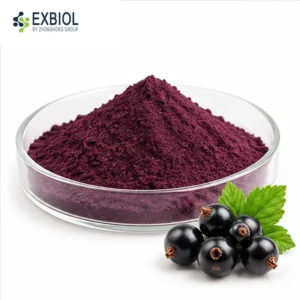
EXBIOL® STANDARDIZED PHYTOCHEMICAL INGREDIENTS Anthocyanin Extract 25% HPLC Manufacturer-direct technical sourcing of standardized berry anthocyanin extracts. Compare Blackcurrant (Ribes nigrum L.) and Bilberry (Vaccinium myrtillus L.) grades by HPLC assay, botanical fingerprint, carrier composition and formulation requirements.
|
01. Anthocyanin Extract 25% — Source Selection
Anthocyanin Extract 25% HPLC is a family-level sourcing description rather than a single botanical identity. Different plant sources may have similar total anthocyanin assay targets but different marker profiles and carrier systems.
EXBIOL presents two separately specified sourcing options: Blackcurrant Extract 25% HPLC and Bilberry Extract 25% HPLC.
02. Choose Your Anthocyanin 25% HPLC Grade
Blackcurrant Extract 25%Ribes nigrum L. Assay: ≥25% total anthocyanins by HPLC. Markers: D3G, D3R, C3G and C3R. Carrier: No added carrier declared in the supplied technical overview, subject to confirmation. Qualification: Four-marker profile, batch assay and carrier declaration. | Bilberry Extract 25%Vaccinium myrtillus L. Assay: ≥25% total anthocyanosides by HPLC. Markers: Multi-anthocyanin glycoside fingerprint. Carrier: 20% maltodextrin declared in the supplied technical overview. Qualification: Multi-peak fingerprint, assay method and carrier percentage. |
Both values are product specification targets. Actual lot results and carrier composition must be verified with the current controlled documents.
03. Blackcurrant vs. Bilberry — Technical Comparison
| Parameter | Blackcurrant | Bilberry |
|---|---|---|
| Species | Ribes nigrum L. | Vaccinium myrtillus L. |
| Plant Part | Fruit | Fruit |
| HPLC Target | Anthocyanins ≥25% | Anthocyanosides ≥25% |
| Fingerprint | Four major markers | Complex multi-peak profile |
| Carrier | No added carrier declared* | 20% maltodextrin declared* |
| Commercial Review | Batch COA + fingerprint | COA + fingerprint + carrier |
*Based on the supplied technical artwork; confirm the actual offered grades.
04. HPLC vs. UV-Vis: What Does 25% Mean?
HPLC and UV-Vis can measure different analytical attributes. UV-Vis methods may estimate total pigment-related content, while a suitable HPLC method separates individual anthocyanin compounds and may quantify selected markers.
A 25% UV-Vis result is not automatically equivalent to 25% by HPLC. The method, reference standard, calculation basis and sample preparation must be compared.
Which reference standards were used? Was quantitation based on weight or peak-area normalization? Which markers were included? Is the method validated for the claimed botanical source?
05. Carrier-Free vs. Maltodextrin 20%
Carrier selection can affect ingredient labeling, powder handling, flowability, blend composition and finished-product development.
- Blackcurrant: Supplied technical overview declares no added carrier; lot confirmation required.
- Bilberry: Supplied technical overview declares 20% maltodextrin.
- For encapsulation: Evaluate flow, density and blend uniformity.
- For beverages: Compare hydration, clarity, sediment and color.
- For clean-label projects: Confirm permitted processing aids and carrier restrictions before quotation.
06. Botanical Authentication & HPLC Fingerprints
Botanical authentication helps distinguish legitimate berry extracts from other anthocyanin-containing materials.
Blackcurrant is often characterized by four major anthocyanin glycosides: D3G, D3R, C3G and C3R.
Bilberry has a more complex profile containing glycosides related to delphinidin, cyanidin, petunidin, peonidin and malvidin.
Reference fingerprints help evaluate identity, but should not be substituted for lot-specific test results.
07. COA & Technical Documentation Requirements
| Document | Qualification Purpose |
|---|---|
| Batch COA | Assay, methods, lot number and release status |
| HPLC Report | Anthocyanin marker profile and assay basis |
| TDS / Specification | Composition, carrier, physical characteristics |
| SDS | Handling and safety information |
| Contaminant Reports | Heavy metals, pesticides, microbiology and solvents |
| Certifications | Current manufacturing-site scope and validity |
Documentation availability and analytical coverage are confirmed for the actual offered grade and batch.
08. Formulation Screening: pH, Heat & Solubility
Anthocyanin-rich ingredients are affected by formulation conditions. Color behavior, marker stability and dispersion depend on pH, temperature, oxygen, light, matrix composition and processing methods.
- Record the target concentration and water temperature.
- Evaluate sediment, turbidity and hydration time.
- Monitor color over the final product’s pH range.
- Assess effects of heat processing and storage.
- Test the carrier-containing and no-added-carrier grades separately.
Neither source is guaranteed to have instant aqueous clarity or a universal stable pH range without actual testing.
09. Regulatory & Intended-Use Qualification
Anthocyanin Extract 25% HPLC may be evaluated as a standardized botanical ingredient for qualified formulation projects, subject to the applicable market requirements.
Regulatory status differs between dietary supplement ingredients, conventional food ingredients, food color additives and cosmetic applications.
Being anthocyanin-rich does not automatically mean a product is authorized as food color E163 or approved for all U.S. color-additive uses.
For U.S. color applications, consult the FDA color additive guidance and applicable regulations.
10. Samples, MOQ & Wholesale Pricing
Commercial sourcing begins with the appropriate botanical grade, matching documents and sample evaluation.
| Sample | Evaluation quantity confirmed by availability and testing needs |
|---|---|
| MOQ | Confirmed by grade and commercial quotation |
| Packaging | Determined by offered lot and quantity |
| Lead Time | Confirmed based on current availability |
| Incoterms | Specify destination and requested trade terms |
Request an itemized quote for trial quantity, first production quantity and estimated annual volume.
11. Batch-to-Batch Consistency & Release Control
Consistent supply requires an agreed specification and analytical method across production lots.
- Verify botanical species and fruit part.
- Check total anthocyanin or anthocyanoside assay.
- Compare HPLC fingerprint patterns using the applicable method.
- Confirm carrier percentage and excipient declaration.
- Review contaminants and microbiological results.
- Match current batch number to its COA and relevant analytical reports.
12. Manufacturing Traceability & Botanical Origin
Procurement teams should trace the extract from botanical raw material through manufacturing, standardization, quality release and packing.
| Stage | Qualification Record |
|---|---|
| Raw Fruit | Source species, origin and receiving lot |
| Extraction | Solvent system and production record |
| Standardization | Assay and carrier addition records |
| Final Testing | COA and analytical method |
| Packing | Lot identification, packaging and dispatch |
Current certifications should be verified against the actual manufacturing site and applicable scope.
13. Particle Size, Mesh & Cold-Water Dispersion
Particle size and dispersibility are relevant to powder processing, blending and finished-product consistency.
- Mesh: Confirm sieve-test result and applicable standard.
- Particle distribution: Request D10/D50/D90 where needed.
- Cold-water dispersion: Measure mixing cycles, concentration and sediment.
- Clarity: Evaluate haze and turbidity for clear applications.
- Powder handling: Review moisture, density and flowability when relevant.
The supplied product graphics list 80-mesh targets; this does not establish instant solubility or guaranteed particle-size distribution.
14. Storage, Stability, Packaging & Logistics
Proper storage and packaging help reduce unnecessary exposure to moisture, light and heat.
- Use packaging appropriate to the selected grade.
- Keep containers tightly closed under the stated storage conditions.
- Confirm shelf life from the current specification and supporting stability records.
- Separate production lead time from international transport and customs estimates.
- Confirm actual commercial stock before committing to delivery dates.
The supplied graphics list two-year shelf-life directions. They should not be interpreted as universal guarantees for every formulation or packaging system.
EXBIOL does not make an unverified fixed 15,000 kg stock or guaranteed three-day dispatch claim on this page.
15. Blackcurrant Four-Marker HPLC Profile
The four principal blackcurrant anthocyanin markers commonly emphasized in analytical profiling are:
| Abbreviation | Compound |
|---|---|
| D3G | Delphinidin-3-O-glucoside |
| D3R | Delphinidin-3-O-rutinoside |
| C3G | Cyanidin-3-O-glucoside |
| C3R | Cyanidin-3-O-rutinoside |
These four markers do not imply that no other anthocyanins are present. Their characteristic pattern supports analytical comparison, but quantitative release requires the batch-specific method and result.
16. Bilberry Multi-Anthocyanin HPLC Profile
Bilberry contains a complex mixture of anthocyanin glycosides. Its HPLC fingerprint commonly includes compounds associated with:
- Delphinidin
- Cyanidin
- Petunidin
- Peonidin
- Malvidin
The supplied Bilberry technical graphic provides a representative HPLC fingerprint and declares 20% maltodextrin. The illustrated 25.32% HPLC result must not be advertised as the assay of a current production batch without matching evidence.
Buyers should request species authentication, lot-matched HPLC data, the approved assay method and the carrier declaration.
17. Application Selection Matrix
| Application | Key Technical Question | Qualification Action |
|---|---|---|
| Capsules | Carrier, flow and blend uniformity | Sample evaluation |
| Powder Sachets | Dispersion and moisture handling | Cold-water test |
| Beverages | pH, heat, turbidity and color | Matrix stability study |
| Analytical R&D | Marker identity and profile | Request HPLC data |
These are formulation-development examples, not disease-treatment claims or confirmation of legal authorization in all markets.
18. Technical RFQ Checklist — From Sample to Bulk Order
For a quotation aligned with the correct technical grade, send the following project details:
| Source | Blackcurrant / Bilberry / Both |
|---|---|
| Assay | 25% HPLC and required method |
| Carrier | No added carrier / 20% maltodextrin accepted |
| Sample | Required quantity and evaluation schedule |
| Order Volume | First order and annual forecast |
| Destination | Country, location and preferred Incoterm |
| Documentation | COA, HPLC, TDS, SDS and regulatory requirements |
| Send Technical RFQ | Email Procurement Team |
19. Frequently Asked Questions
Is Anthocyanin Extract 25% always made from bilberry?
No. Anthocyanin-rich extracts can come from multiple botanical sources. EXBIOL presents Blackcurrant and Bilberry as separate product grades.
Are Blackcurrant 25% and Bilberry 25% interchangeable?
Not automatically. Botanical source, HPLC profile, carrier and formulation characteristics differ.
Is 25% UV-Vis equivalent to 25% HPLC?
No. The measurement methods and calculation bases may differ. Compare the actual procedures and reference standards.
Which grade contains maltodextrin?
The supplied Bilberry technical overview declares 20% maltodextrin. The Blackcurrant overview declares no added carrier, subject to current-lot verification.
Can EXBIOL provide batch-specific HPLC data?
Customers can request available lot-matched chromatograms and analytical documentation during technical qualification.
Are both grades instantly water-soluble?
Instant clarity and cold-water dispersion have not been established as universal properties. Buyers should test the selected grade under application-specific conditions.
Can I request 1 kg, 25 kg or 100 kg pricing?
Yes, quotations may be requested at these quantities. Actual MOQ, availability, packaging and lead time are confirmed individually.
Does the 25% grade have automatic food-color approval?
No. Regulatory status depends on product identity, processing, intended use and destination-market regulations.
20. Scientific References & Regulatory Disclaimer
Reference 1 — Blackcurrant Anthocyanin Identification
Slimestad R, Solheim H. Anthocyanins from black currants (Ribes nigrum L.). Journal of Agricultural and Food Chemistry. 2002.
Reference 2 — Bilberry HPLC Fingerprint Authentication
Liu B, Hu T, Yan W. Authentication of the Bilberry Extracts by an HPLC Fingerprint Method Combining Reference Standard Extracts. Molecules. 2020.
Reference 3 — U.S. Regulatory Context
U.S. Food and Drug Administration. Summary of Color Additives for Use in the United States in Foods, Drugs, Cosmetics, and Medical Devices.
The references provide general scientific and regulatory context and do not validate a particular EXBIOL production batch, establish medical efficacy, or constitute market-specific authorization. Customers must review the actual product specification, analytical records, safety documentation, intended application and applicable regulatory requirements. No disease-treatment claims are made.
EXBIOL® B2B INGREDIENT QUALIFICATION Ready to Source Anthocyanin Extract 25% HPLC? Select Blackcurrant or Bilberry. Confirm your carrier requirements, desired quantity and target application. Request batch documentation, evaluation samples and a project-specific commercial quotation.
|