B2B ingredient sourcing and technical qualification for a proposed ≥25.0% HPLC total anthocyanin grade. Distinguish the representative D3G/D3R/C3G/C3R profile from actual batch release evidence before approving material for formulation.
| TARGET ≥25% HPLC | D3G / D3R / C3G / C3R | CARRIER-FREE · DECLARED | BATCH COA ON REQUEST |
| 📑 Request Batch COA | 🏭 Request Bulk Quote |
1. Two-Track Qualification: Procurement & R&D
Evaluate Supply Without Guesswork
Request a quote for a named Blackcurrant Extract 25% HPLC grade with confirmed quantity, batch availability, packing format, Incoterms and sample lead time.
For new programs, submit your initial trial and annual demand together so the production and QC teams can assess a workable supply plan.
Verify the Four-Marker Identity
Review the identity of Ribes nigrum, the D3G/D3R/C3G/C3R chromatographic pattern, analytical quantitation basis, carrier declaration and formulation requirements.
A representative fingerprint helps explain the method; only a matching batch record establishes lot-specific conformity.
2. Botanical Identity and Extract Definition
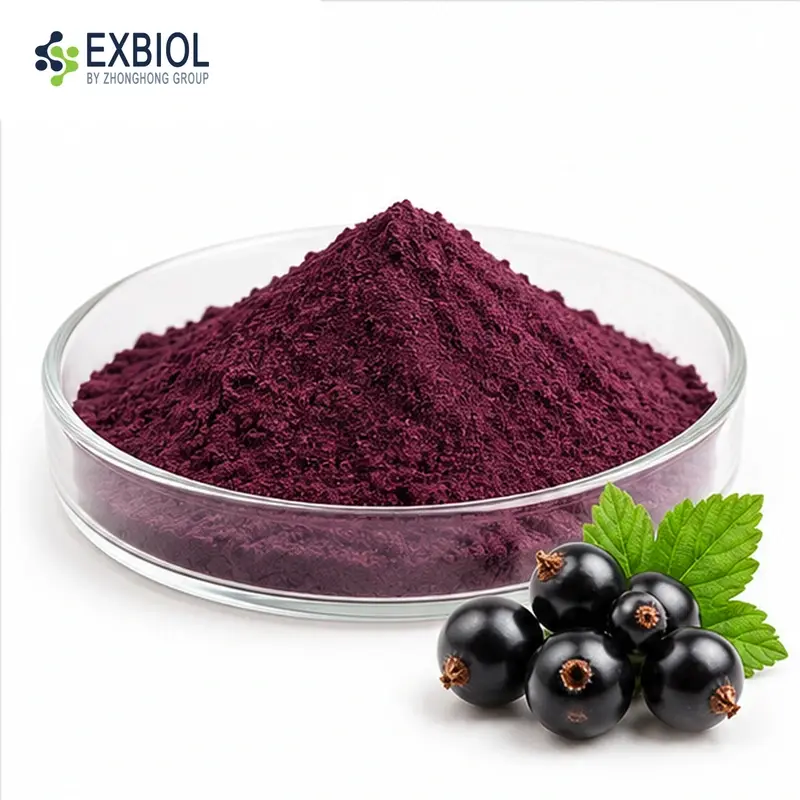
EXBIOL® Blackcurrant Extract 25% HPLC is a standardized botanical ingredient derived from the fruit of *Ribes nigrum* L., with a proposed specification of ≥25.0% total anthocyanins determined by an agreed HPLC method.
The botanical is blackcurrant—not bilberry, blueberry, aronia or black rice. These sources can all contain anthocyanins, but they differ in glycoside profiles, accompanying polyphenols and formulation behavior.
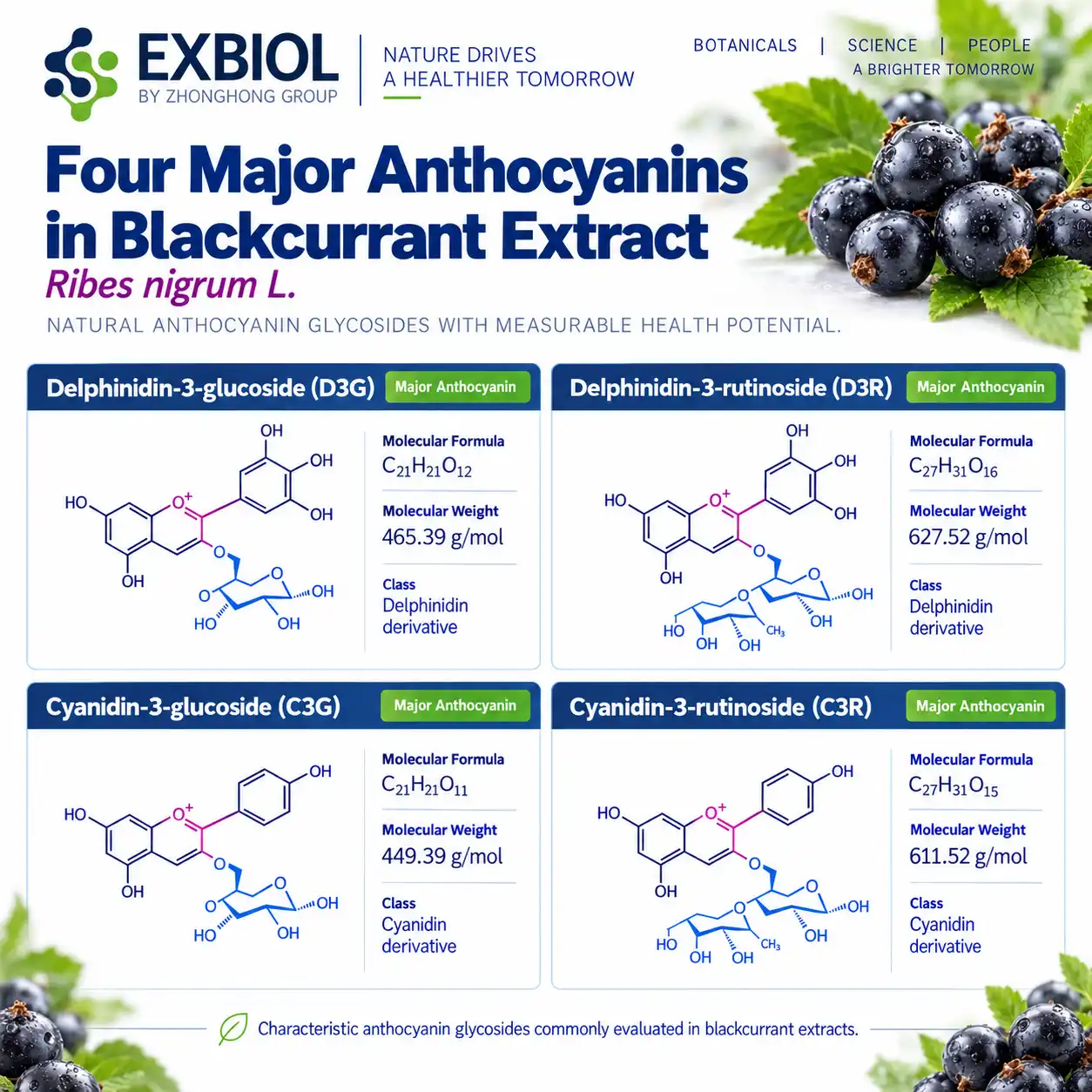
3. Key Molecular Markers: D3G, D3R, C3G and C3R
Four glycosides form a characteristic, literature-supported blackcurrant anthocyanin fingerprint. Peak ratios depend on plant variety, maturity, extraction and method conditions.
| Marker | Full compound name | Role in HPLC qualification |
|---|---|---|
| D3G | Delphinidin-3-O-glucoside | Characteristic identification marker |
| D3R | Delphinidin-3-O-rutinoside | Often a prominent blackcurrant marker |
| C3G | Cyanidin-3-O-glucoside | Characteristic identification marker |
| C3R | Cyanidin-3-O-rutinoside | Often a prominent blackcurrant marker |
The four markers are chemically distinct and must not be treated as one molecule, one molecular formula or one generic CAS number.
4. Technical Snapshot: 12 Buyer-Ready Parameters
This dashboard separates a proposed grade specification from confirmed analytical results. The current batch must be qualified against the intended acceptance limits.
5. HPLC Quantitation: What Does ≥25% Mean?
The reported total anthocyanin percentage must be connected to a defined HPLC method. Buyers should confirm which glycosides are quantified, which reference standards are used, how response factors are applied and whether the result is reported as a sum of compounds or as an equivalent of one standard.
- Use a validated or suitably qualified HPLC-DAD method for the required matrix.
- State detection wavelength and retention-time acceptance rules; the illustrative figure references 535 nm.
- Define external-standard calibration, response factors, concentration units and reporting basis.
- Specify whether the value is % w/w of finished extract, dry-basis content or another basis.
6. Representative Four-Peak Chromatogram — Identity Only
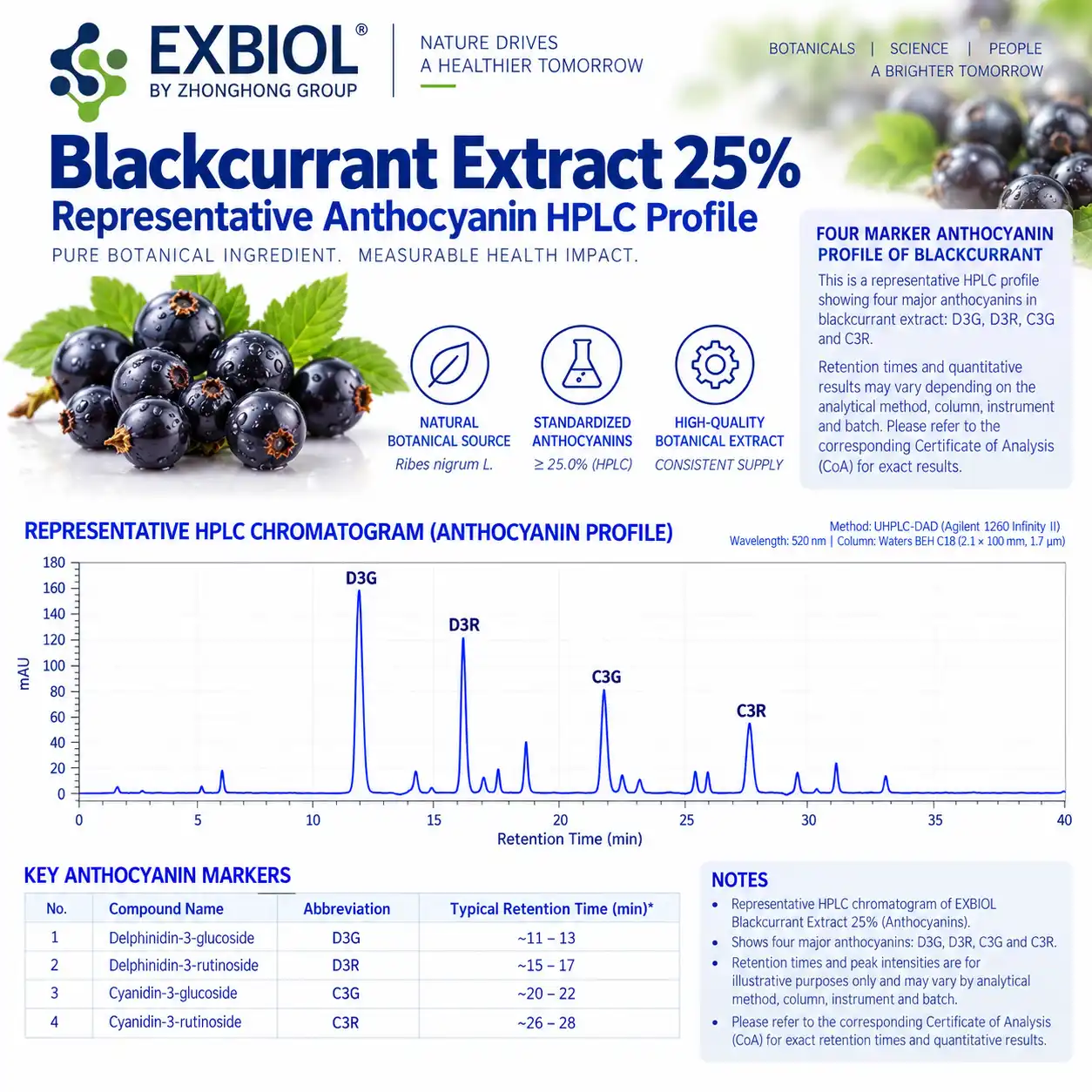
The supplied EXBIOL technical poster depicts a representative HPLC-DAD fingerprint with four annotated peaks: D3G, D3R, C3G and C3R, with D3R shown as a major peak. The poster lists approximate retention-time windows rather than a signed current-lot chromatographic report.
| Figure item | What can be stated | What must not be inferred |
|---|---|---|
| Detector | Representative 535 nm detection | Not proof that a current lot was analyzed at 535 nm |
| Peaks | Four main glycosides labeled | Not a complete impurity profile |
| Retention times | Approx. 17–30 min shown for illustrative conditions | Not fixed RT values for every HPLC system |
| Peak-area table | Blank / not supplied | No verified area %, concentration or batch assay |
7. Batch COA and Analytical Evidence Matrix
For B2B qualification, the actual batch should be linked to the batch number, analytical method revision and current signed COA. Below is a document-request matrix, not a table of measured results.
| Evidence | Proposed criterion or relevance | Current status |
|---|---|---|
| Botanical identity | Ribes nigrum fruit; traceable material ID | Request source records |
| Total anthocyanins | Target ≥25.0% w/w by agreed HPLC method | Current signed COA required |
| Marker fingerprint | D3G, D3R, C3G, C3R | Representative poster only |
| Carrier declaration | None declared in supplied poster | Signed formula / lot declaration required |
| Residual solvents | Ethanol and other relevant solvents | Lot GC or equivalent report required |
| Metals / micro / pesticides | Buyer-market specification | Lot-specific reports required |
| Moisture and particle size | ≤5% LOD; 80-mesh sieve target | Lot-specific results required |
8. Carrier-Free Grade: What the Statement Actually Means
The supplied marketing sheet identifies the proposed Blackcurrant 25% grade as carrier-free with no declared maltodextrin or other added excipients. The statement should be checked against the controlled ingredient composition and matching production batch.
Carrier-free does not mean 100% anthocyanin. A 25% anthocyanin extract naturally includes additional berry-derived constituents; it is not a 100% purified anthocyanin isolate.
For customers manufacturing powder sticks, capsules or tablets, carrier-free grades may require independent evaluation of flow, caking, hygroscopicity, dosing uniformity and handling. No universal processing advantage is guaranteed.
9. Extraction Ratio and Fresh-Fruit Basis
The technical image quotes approximately 100:1 with the qualifier “fresh fruit origin.” This is a declared raw-material-to-finished-extract ratio; it should not be presented as 100:1 on a dry botanical basis or as proof of a specific concentration yield without process records.
A sourcing team should verify the starting material moisture, manufacturing yield basis, extraction stages and the way carrier-free content is calculated. The final released assay, identity and contaminants are more relevant than an isolated ratio number.
10. Extraction Solvent System and Residual Solvents
The supplied technical sheet describes an ethanol/water extraction system. This is a process declaration, not a GC residual-solvent test. The page therefore does not promise “methanol-free,” “solvent-free” or nondetectable residues without a matching certificate.
For each supply lot, QC should confirm relevant residual solvents, target-market limits, analytical methods and detection/reporting thresholds. A solvent’s absence from the process recipe alone does not guarantee its nondetection in every laboratory result.
11. Particle Size, Flowability and Handling
The illustrative Blackcurrant technical specification states a target of 100% passing 80 mesh. This is a sieve-based specification, not a laser-diffraction D90 result and not a declaration that the powder is micronized.
For automatic filling equipment and sachet lines, evaluate flowability, bulk/tapped density, particle-size distribution, cohesion and hygroscopicity with the actual delivered material. A small R&D sample may not reveal every production-scale filling issue.
If you need a specific mesh size or granulation, request feasibility and a matching sieve/PSD result before commercial approval.
12. Water Dispersibility, Color and pH
Blackcurrant anthocyanins are highly sensitive to matrix chemistry. The technical sheet describes water solubility/dispersibility, but this does not demonstrate instant cold-water dissolution, optical clarity or absence of sediment in a finished formulation.
The color of an anthocyanin-containing formula may shift as pH, temperature, light, oxygen, ascorbic acid, ions and other ingredients change. Acidic systems often preserve red/purple forms better than neutral or alkaline matrices, but a universal stability range should not be claimed.
13. Stability, Shelf Life and Packaging Control
The supplied poster gives a proposed shelf life of two years with cool, dry, light-protected storage. That can be listed as an indicative commercial specification, but the actual expiry or retest date must come from the accepted batch COA and supported stability protocol.
- Use tight, moisture-resistant, food-contact-appropriate primary packaging for the intended market.
- Control temperature, humidity, oxygen exposure and light during storage and sampling.
- Inspect color, moisture, assay and fingerprint at stability checkpoints.
- Confirm shelf-life assignment based on tested packs and storage conditions.
Evaluating Blackcurrant Anthocyanins 25% for Your Formulation?
Request a matched lot COA, the actual HPLC chromatogram, carrier declaration or a 20 g evaluation sample. Commercial quantities and terms are confirmed by written quotation.
Please specify intended use, target market, order quantity, carrier preference and analytical requirements. Documents are supplied subject to lot availability and release authorization.
14. Contaminant and Microbiological Qualification
This botanical extract requires a product- and market-specific control plan covering elemental impurities, microbiology, pesticide residues, mycotoxins if relevant, and residual solvents. The illustrative sheet uses broad references to compliance and test methods; it does not provide a complete signed, quantified lot record.
| Test family | Common buyer question | Required evidence |
|---|---|---|
| Pb, As, Cd, Hg | What are the numerical limits and actual results? | ICP-MS or validated assay report |
| Microbial limits | Are results within the intended food/supplement specification? | Microbial methods, counts, specified pathogens |
| Pesticide multi-residue | Which target-market residues and reporting limits apply? | Test list, LOQs and lot outcome |
| Aflatoxins / mycotoxins | Are they within application-specific limits? | Risk assessment and result where required |
| Residual solvents | Is the declared ethanol/water process supported by testing? | Suitable GC report or alternative method |
15. Manufacturing and Lot-to-Lot Consistency
Controlled processing should preserve identity from harvested fruit through extraction, concentration, purification, drying and packaging. Each commercial lot should be assigned a traceable release record and tested against approved specifications.
EXBIOL’s technical qualification objective is to compare total anthocyanin assay and marker fingerprint together—rather than only reporting a single percentage. Instrument response, retention times and natural cultivar variation must be evaluated with method-defined acceptance limits.
16. Applications: Supplements, Powders and Functional Foods
Relevant buyer projects may include powder sachets, capsules, tablets, nutrition blends and formulation research. Application feasibility depends on local regulatory status, intended use level and finished-product compatibility.
Powder Blends
Evaluate dark-purple hue, taste impact, dusting, hygroscopicity, blend uniformity and water-dispersion performance.
Capsules / Tablets
Assess actual powder handling, compatibility, stability and active-assay delivery through the finished manufacturing process.
Beverage Concepts
Test color and anthocyanin retention under actual pH, heat, packaging and shelf-life conditions; do not assume legal color-additive permission.
17. Blackcurrant vs Bilberry: Source-Specific Qualification
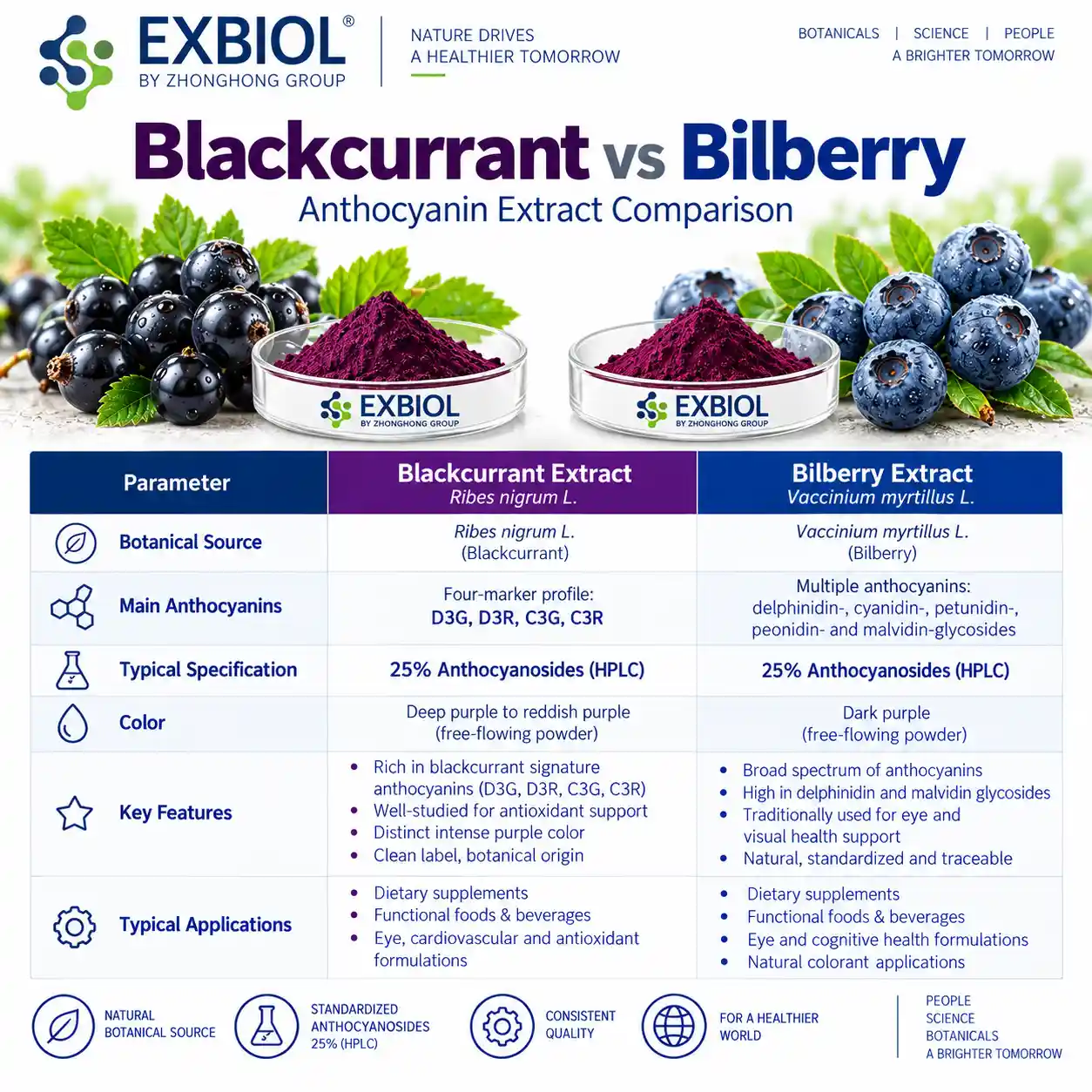
Blackcurrant (Ribes nigrum) and bilberry (Vaccinium myrtillus) may both carry a 25% HPLC anthocyanin-related claim, but they cannot be treated as interchangeable products. They have different botanical origins, different chromatographic distribution and potentially different carrier systems.
| Buyer criterion | Blackcurrant grade in supplied sheet | Bilberry grade in supplied sheet |
|---|---|---|
| Latin name | Ribes nigrum L. | Vaccinium myrtillus L. |
| Characteristic HPLC | Four main markers D3G/D3R/C3G/C3R | Broader multi-anthocyanin fingerprint |
| Carrier | Declared no added carrier; pending lot verification | Separate illustrative sheet declares maltodextrin 20%; verify lot |
| Supply documentation | Blackcurrant-specific COA & HPLC | Bilberry-specific COA & HPLC |
For other berry-source options, use the Anthocyanin Extract 25% Source & Grade Comparison and request a separate specification for each botanical origin.
18. Commercial Ordering, Evaluation Samples and Qualification
Requesting an evaluation sample is the first practical step when reformulating from an existing anthocyanin extract. Buyers should provide their required assay basis, marker profile, carrier rules, target application and desired first-order quantity.
- Sample: specify desired evaluation mass (for example, 20 g) and whether a matched batch COA is essential.
- Commercial RFQ: specify 1 kg, 25 kg, 100 kg or annual forecast as appropriate; prices are not assumed.
- Terms: request named Incoterms (FOB / CFR / DAP / DDP where feasible), lead time and packaging.
- Documentation: batch COA, full HPLC/identity evidence, TDS, SDS, carrier declaration and market-specific tests.
- Acceptance: agree the marker sum, wet/dry assay basis and contaminant limits before purchase.
19. Technical FAQ for Purchasing, QA and Formulation
What is the difference between Blackcurrant Extract 25% HPLC and generic anthocyanin powder?
This grade specifies Ribes nigrum fruit origin and a four-marker HPLC identity approach. Generic anthocyanin materials may come from other botanicals or use different assay methods; a 25% label alone does not establish equivalence.
Which four anthocyanins are characteristic of blackcurrant?
Delphinidin-3-O-glucoside (D3G), delphinidin-3-O-rutinoside (D3R), cyanidin-3-O-glucoside (C3G), and cyanidin-3-O-rutinoside (C3R). Relative distributions can vary by cultivar and analysis method.
Does the illustrative HPLC figure prove a specific batch contains 25% anthocyanins?
No. It illustrates the expected four-peak pattern. A signed batch COA and a quantitative HPLC report with standards, calibration and actual integration data are needed to prove lot-specific assay.
Is the Blackcurrant Extract 25% grade carrier-free?
The supplied technical sheet declares no added carrier for the proposed grade. Buyers should request a current-lot composition declaration before using carrier-free or maltodextrin-free claims in their own documents.
Does carrier-free mean 100% anthocyanins?
No. Carrier-free refers to the absence of intentionally added excipients, while the standardized anthocyanin assay target is 25% of the extract by the stated method.
Is the powder fully water-soluble or instantly clear in beverages?
The proposed technical sheet describes water solubility or dispersibility, but optical clarity and cold-water dissolution must be tested in the actual beverage or formulation system.
Can Blackcurrant 25% be substituted for Bilberry 25%?
Not automatically. The botanicals differ in marker fingerprints, specifications, carrier system and potentially regulatory suitability. Request separate botanical and batch qualification.
Can EXBIOL provide 20 g samples and bulk pricing?
A 20 g evaluation quantity and commercial price tiers may be requested. Availability, testing records, packaging, lead time and quoted terms are confirmed for the relevant batch and destination.
Is the raw material automatically approved as E163 or as a US food color additive?
No. EFSA evaluations of anthocyanins (E163) address specified regulatory contexts and compositions. Buyers must verify legal identity, extraction process, purity and permitted uses in each target market; US color additive authorization is not assumed.
How should an R&D team compare HPLC and UV-Vis anthocyanin results?
Confirm calibration standards, sample preparation, methods, reporting basis and units. A UV total-pigment or color measurement should not be presented as equivalent to a specified HPLC sum without method validation.
20. References, Regulatory Context and Scientific Disclaimer
Independent literature is used to explain source chemistry and analytical/regulatory context. None of the references validates the identity, 25% HPLC assay, carrier-free status, shelf life or end-product performance of an untested EXBIOL batch.
Slimestad R, Solheim H. Anthocyanins from black currants (Ribes nigrum L.). J Agric Food Chem. 2002;50(11):3228–3231. DOI: 10.1021/jf011581u. PMID: 12009991.
Literature support for the four principal blackcurrant anthocyanin glycosides and additional minor compounds.
Evaluation of Anthocyanin Profiles in Various Blackcurrant Cultivars over a Three-Year Period Using a Fast HPLC-DAD Method. PMID: 34441523.
Shows variable relative marker distribution by cultivar and explains why total assay method matters.
EFSA ANS Panel. Scientific Opinion on the re-evaluation of anthocyanins (E 163) as a food additive. EFSA Journal. 2013;11(4):3145. DOI: 10.2903/j.efsa.2013.3145.
Addresses E163 scientific and food-additive assessment under stated source/processing conditions; does not approve this EXBIOL lot.
⚠ Scientific, Regulatory & Commercial Disclaimer
The cited scientific literature concerns studied blackcurrant materials and anthocyanins, not a release test or clinical trial of the specific EXBIOL product. No therapeutic, visual-performance or disease-prevention outcome is guaranteed. Finished-product claims, ingredient suitability, dosing and labeling are subject to separate evaluation.
EFSA’s E163 opinion does not automatically classify, authorize or approve this particular extract as a food color additive. United States color-additive and other market-specific rules must also be independently checked. Batch quality claims require a signed current-lot COA and matching analytical data; proposed grades and representative chromatograms are not release evidence.
Evaluating Blackcurrant Anthocyanins 25% for Your Formulation?
Request a matched lot COA, the actual HPLC chromatogram, carrier declaration or a 20 g evaluation sample. Commercial quantities and terms are confirmed by written quotation.
Please specify intended use, target market, order quantity, carrier preference and analytical requirements. Documents are supplied subject to lot availability and release authorization.
EXBIOL® by Shaanxi Zhonghong Investment Technology Co., Ltd. — manufacturer qualification support for standardized botanical extracts and analytical documentation.
ISO / GMP / HACCP certificates may be supplied where valid and applicable to the actual manufacturing site and process. Company certifications do not by themselves certify a particular ingredient batch. Please request certificate number, issuing body and scope.