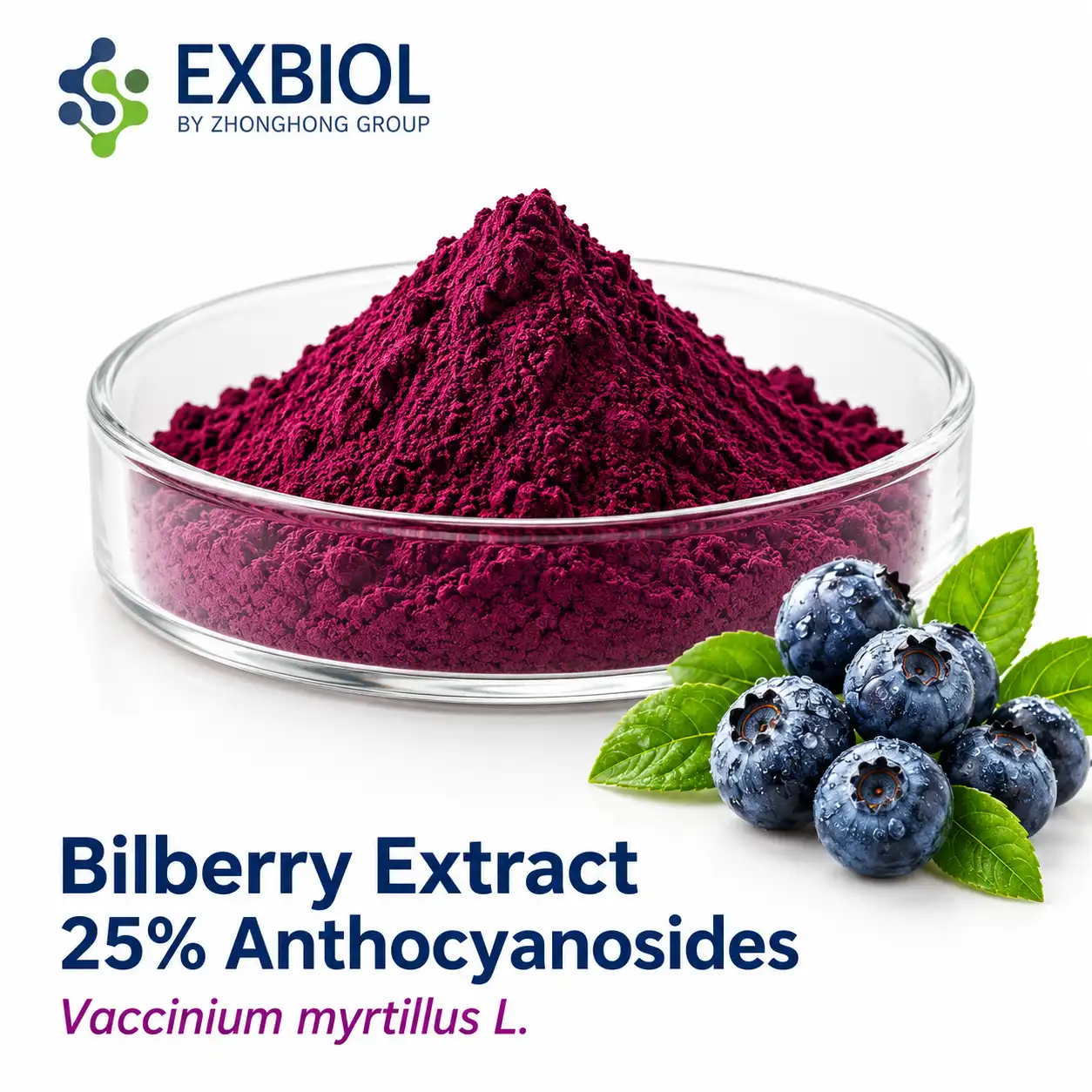
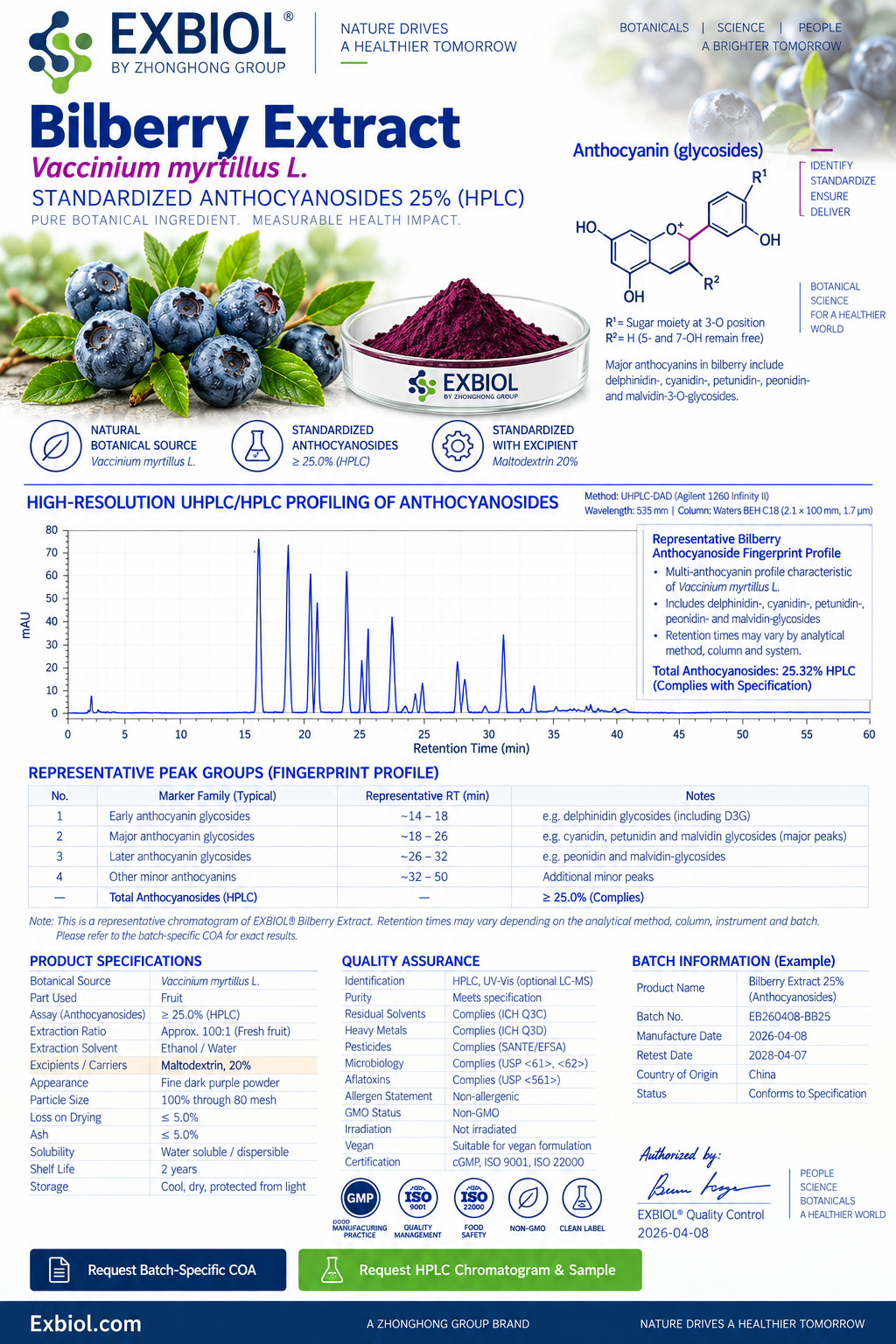
EXBIOL® STANDARDIZED HERBAL EXTRACT Bilberry Extract 25% Anthocyanosides (HPLC) EXBIOL® Bilberry Extract is derived from the fruit of Vaccinium myrtillus L. and standardized to a target of ≥25.0% total anthocyanosides by HPLC. The specified formulation contains 20% maltodextrin carrier and is intended for qualified ingredient sourcing, analytical evaluation and formulation R&D.
|
01. Procurement & R&D Qualification
🏭 Procurement TrackFor ingredient buyers, supplement manufacturers and distributors:
| 🔬 R&D / QA TrackFor formulation, analytical and quality teams:
|
02. What Is Bilberry Extract 25% HPLC?
Bilberry Extract 25% HPLC is a standardized botanical ingredient derived from the fruit of Vaccinium myrtillus L.
It contains a mixture of naturally occurring anthocyanin glycosides and other botanical extract components.
The 25% specification refers to total anthocyanosides determined by the approved HPLC method. It does not mean that the powder contains 25% of one isolated compound.
Bilberry is botanically different from blackcurrant (Ribes nigrum) and cultivated blueberry (Vaccinium corymbosum).
03. Botanical Identity & Composition
| Botanical Source | Vaccinium myrtillus L. |
|---|---|
| Plant Part | Fruit |
| Ingredient Type | Standardized Botanical Extract |
| Active Marker Group | Total Anthocyanosides |
| Declared Carrier | Maltodextrin 20% |
| Molecular Formula | Not applicable to botanical mixture |
Botanical identity and composition must match the approved specification and current batch documentation.
04. Technical Specification Dashboard
| Assay ≥25.0% by HPLC | Carrier 20% Maltodextrin |
| Appearance Dark-purple powder | Particle Size 100% through 80 mesh* |
| Loss on Drying ≤5.0%* | Ash ≤5.0%* |
| Extraction Solvent Ethanol / Water* | Extract Ratio Approx. 100:1* |
| Solubility Water-dispersible* | Shelf Life 24 months listed* |
| Botanical Source Vaccinium myrtillus L. | Plant Part Fruit |
*Values shown in the supplied technical overview; confirm current specification and batch results before commercial release.
05. Why Does the 20% Maltodextrin Carrier Matter?
The specified Bilberry Extract contains 20% maltodextrin. This carrier may influence physical handling, formulation characteristics and labeling requirements.
- The product must not be marketed as carrier-free.
- The carrier percentage should be declared consistently in the product specification.
- Formulators should account for the carrier in their final formulation.
- The origin and labeling implications of maltodextrin should be assessed.
- The 25% HPLC assay and 20% carrier declaration must be evaluated on their documented calculation bases.
06. Bilberry Anthocyanin Fingerprint
Bilberry contains a complex mixture of anthocyanin glycosides derived from five principal anthocyanidin families.
- Delphinidin
- Cyanidin
- Petunidin
- Peonidin
- Malvidin
The relative chromatographic pattern can help laboratories assess botanical identity and investigate possible adulteration.
A single total-assay value does not fully describe the anthocyanin fingerprint. A lot-matched HPLC chromatogram should be reviewed during qualification.
07. Representative HPLC Chromatogram
The supplied technical illustration presents a representative HPLC-DAD fingerprint of Bilberry Extract at 535 nm.
| Peak Region | Representative RT | Interpretation |
|---|---|---|
| Early glycosides | ~14–18 min | Early-eluting anthocyanins |
| Major glycosides | ~18–26 min | Major fingerprint region |
| Later glycosides | ~26–32 min | Later-eluting compounds |
| Minor components | ~32–50 min | Additional low-intensity peaks |
Graphic-reported conditions: UHPLC-DAD, 535 nm; Agilent 1260 Infinity II; Waters BEH C18 column; flow 0.3 mL/min; column temperature 40°C.
08. HPLC Assay: Total Anthocyanosides ≥25%
The target commercial specification is total anthocyanosides ≥25.0% by HPLC.
The quantitation method, reference standards, integration procedure and assay calculation basis should be confirmed from the approved analytical method.
HPLC peak area percentage and mass-based assay percentage are not automatically interchangeable.
The supplied technical artwork contains a representative value of 25.32% HPLC. It should only be presented as a specific batch result once verified against the corresponding COA.
09. Batch COA & Quality Matrix
| Parameter | Specification | Evidence |
|---|---|---|
| Botanical Identity | Vaccinium myrtillus L. | Identity record |
| Anthocyanosides | ≥25.0% HPLC | Batch assay |
| Carrier | 20% Maltodextrin | Composition declaration |
| Loss on Drying | ≤5.0% listed | COA result |
| Ash | ≤5.0% listed | COA result |
| Particle Size | 80 mesh listed | Sieve analysis |
| Contaminants | Approved limits | Batch reports |
10. Extraction Process & Carrier Addition
The supplied technical overview lists ethanol/water extraction and an approximate fresh-fruit extraction ratio of 100:1.
For technical qualification, verify the extraction-ratio calculation basis, solvent-removal process, maltodextrin addition, carrier proportion and final assay method.
The extraction ratio alone does not establish the actual anthocyanoside concentration or manufacturing yield.
11. Solubility & Powder Formulation
The supplied technical overview describes the ingredient as water-soluble or water-dispersible.
Actual dispersion, color and clarity depend on concentration, temperature, mixing conditions, pH and the formulation matrix.
Recommended evaluation parameters include hydration time, sedimentation, turbidity, blend uniformity and color stability.
Instant aqueous clarity or specific cold-water dispersibility should not be guaranteed without corresponding test results.
12. Storage, Packaging & Stability
The supplied technical overview recommends cool, dry storage protected from light and lists a two-year shelf life.
- Protect the ingredient from excessive heat and direct sunlight.
- Use suitable moisture-barrier packaging.
- Keep containers tightly sealed.
- Evaluate color stability and anthocyanin retention in finished products.
- Confirm shelf life against the current approved stability records.
Commercial packaging and shelf-life claims must correspond to the offered batch and validated storage conditions.
EXBIOL® TECHNICAL QUALIFICATION Need to Qualify the 20% Maltodextrin Grade? Request batch documents, HPLC fingerprint data and formulation information.
|
13. Heavy Metals, Pesticides & Residual Solvents
Quality qualification should include the relevant contaminant panel for the intended market and application.
- Heavy Metals: Pb, As, Cd and Hg.
- Pesticide Residues: Applicable multi-residue screening.
- Residual Solvents: Assessment appropriate to the manufacturing process and specification.
- Aflatoxins: Testing where required by the specification or destination market.
Request measured results, specification limits, units, methods and reporting limits from actual batch documentation.
Unqualified statements such as “zero pesticides” or “zero heavy metals” should not replace analytical evidence.
14. Microbiological Qualification
Microbiological requirements should be selected according to the intended use, approved product specification and destination market.
- Total aerobic microbial count
- Yeast and mould
- Specified pathogens where applicable
- Sampling plan and analytical methods
Where USP <61> or USP <62> methods are referenced, confirm the specific method and microorganism panel applied by the laboratory.
15. Certification & Regulatory Documentation
The supplied technical illustration references cGMP, ISO 9001, ISO 22000, non-GMO, non-irradiated and vegan-related declarations.
Customers should request current certificates, manufacturing-site scope, validity dates, origin statements and product-specific declarations where applicable.
No certification or regulatory approval should be assumed for every batch or destination market solely from the technical illustration.
16. Application & Formulation Development
Subject to finished-product validation and local regulatory requirements, the extract may be evaluated for:
- Nutraceutical powders and sachets
- Capsules and tablets
- Botanical premixes
- Functional food formulation research
Carrier composition, pH, processing temperature, moisture and interactions with other ingredients should be considered during development.
These are formulation-development applications, not medical or therapeutic claims.
17. Bilberry vs. Blackcurrant Extract 25%
| Property | Bilberry | Blackcurrant |
|---|---|---|
| Source | Vaccinium myrtillus | Ribes nigrum |
| Assay | ≥25% Anthocyanosides HPLC | ≥25% Anthocyanins HPLC |
| Carrier | 20% Maltodextrin | Verify specified grade |
| Fingerprint | Multi-anthocyanin profile | D3G / D3R / C3G / C3R |
Although both products use a 25% HPLC target, they are not interchangeable without reviewing the botanical source, analytical method, carrier system and formulation behavior.
18. Bulk Supply, MOQ & Sample Qualification
For a commercial quotation, please provide:
- Required purchase quantity
- Destination country and delivery location
- Intended formulation or application
- Carrier restrictions and analytical requirements
- Preferred packaging and Incoterms
Sample availability, MOQ, unit price, lead time and shipping conditions are confirmed by individual quotation.
19. Frequently Asked Questions
What does Bilberry Extract 25% HPLC mean?
It refers to a target minimum of 25% total anthocyanosides measured by the approved HPLC method. Actual results must be confirmed by the batch COA.
Does the ingredient contain maltodextrin?
Yes. The supplied product specification overview declares 20% maltodextrin.
Is the product carrier-free?
No. This grade contains maltodextrin and should not be marketed as carrier-free.
Which anthocyanins occur in bilberry?
Bilberry contains glycosides derived from delphinidin, cyanidin, petunidin, peonidin and malvidin.
Is the HPLC fingerprint batch-specific?
The supplied illustration is representative. A batch-specific chromatogram should be requested for lot qualification.
Is bilberry extract water-soluble?
The technical overview describes it as water-soluble or dispersible. Actual clarity and dispersion behavior depend on the formulation and test conditions.
What shelf life is listed?
The technical overview lists two years, subject to the approved stability and packaging documentation.
Can EXBIOL provide a COA?
Customers can request the available batch COA, HPLC report and related technical documentation for the offered lot.
How do I request samples or pricing?
Provide your target quantity, destination, application and required technical documentation through the contact page.
How does bilberry differ from blackcurrant?
Botanical sources, anthocyanin fingerprints and the declared carrier formulations differ. Each product requires separate qualification.
20. References & Regulatory Context
Reference 1 — HPLC Fingerprint Authentication
Authentication of the Bilberry Extracts by an HPLC Fingerprint Method Combining Reference Standard Extracts. Molecules, 2020.
Reference 2 — Bilberry Quality Assessment
Quality Assessment of Bilberry Fruits (Vaccinium myrtillus) and Bilberry-Containing Dietary Supplements. Journal of Agricultural and Food Chemistry, 2021.
Reference 3 — Anthocyanin Adulteration Analysis
Bilberry adulteration: identification and chemical profiling of anthocyanins by different analytical methods. Journal of Agricultural and Food Chemistry, 2014.
Scientific & Regulatory Disclaimer
External references support general scientific discussion of bilberry anthocyanins and analytical methods. They do not establish that EXBIOL ingredients prevent, treat or cure disease, nor do they establish regulatory approval for all finished-product uses. Buyers must verify batch-specific specifications, carrier composition, analytical evidence, safety and market-specific requirements.
EXBIOL® BATCH QUALIFICATION Ready to Evaluate Bilberry Extract 25% HPLC? Start with current batch documentation, the maltodextrin declaration, HPLC data and commercial requirements.
|
Batch Documentation | Analytical Review | Manufacturing Qualification | Export Support
Certificates and technical records are supplied according to current manufacturing-site scope, product grade and document availability.