Berberine HCl Manufacturer | Bulk 97% 98% HPLC Powder | Wholesale Crystalline Supply
Leading Industrial Manufacturing of High-Purity Berberine Hydrochloride Solutions.
As the life-science division of Zhonghong Group, Exbiol® leverages 29 years of phytochemical engineering to provide premium Berberine HCl bulk supply. For Sourcing Managers, we eliminate “Line-Down” risks with a 15,000kg ready-stock inventory for 3-5 day global dispatch. For R&D Specialists, we resolve the “Adulteration & Impurity” challenge by providing HPLC-verified purity (97% Standard / 98% Premium) with strictly controlled Palmatine and Jatrorrhizine levels. Our GMP-certified facility ensures zero chemical residues and 100% batch-to-batch molecular consistency (USP/EP compliant) for global pharmaceutical and nutraceutical leaders.
1. What is Berberine HCl?
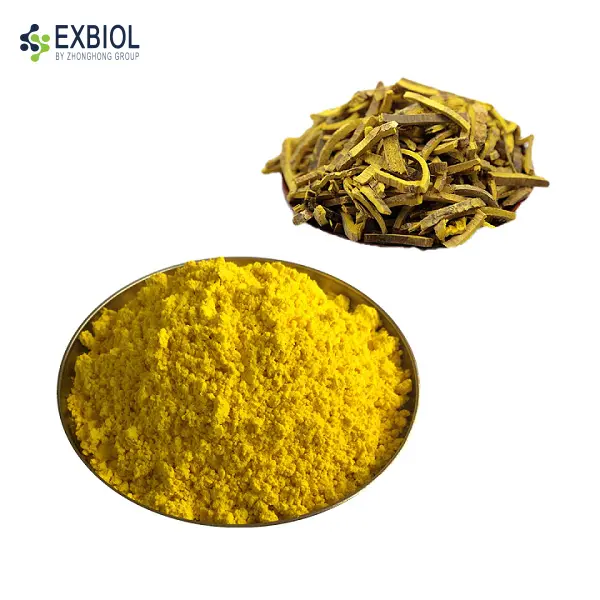
Berberine HCl (Berberine Hydrochloride) is a quaternary ammonium isoquinoline alkaloid derived from plants such as Phellodendron amurense or Berberis aristata. In the industrial sector, it is utilized as a refined yellow crystalline active for its “AMPK-activating” functional properties. Exbiol® focuses on the hydrochloride salt form due to its superior chemical stability and compression performance in solid dosage manufacturing.
2. Physicochemical Technical Specifications
| Parameter | Engineering Standard (USP/BP Compliant) |
|---|---|
| Molecular Formula | C20H18ClNO4 · 2H2O |
| Assay (HPLC) | ≥ 97.0% (Standard) | ≥ 98.0% (Premium) |
| Particle Size | 100% through 80 Mesh (Micronized available) |
| Loss on Drying | ≤ 12.0% (Hydrate Form) |
| Melting Point | Approx. 190°C (with decomposition) |
3. Source & Botanical Origin
Exbiol® sources authentic Phellodendron amurense bark and Berberis aristata root through long-term farming partnerships. Every incoming lot of raw biomass is DNA-tested to ensure alkaloid-rich species authenticity. We utilize a multistage recrystallization process to isolate pure berberine from other naturally occurring but less active alkaloids, ensuring a clean isolate for pharmaceutical applications.
4. Mechanism of Action
The primary mechanism of Berberine HCl is the activation of Adenosine Monophosphate-activated Protein Kinase (AMPK). This “metabolic master switch” regulates glucose and lipid metabolism. At the cellular level, Berberine HCl may support the functional property of increasing LDL-receptor expression and modulating intestinal microbiota, supporting overall metabolic homeostasis.
5. Functional Application Benefits
- Metabolic Support: Functional property for glucose-energy homeostasis support.
- Lipid Equilibrium: May support the functional property of healthy cholesterol levels.
- GI Integrity: Functional active in supporting intestinal mucosal barrier health.
- Bio-purity: Crystalline form ensures high density for optimal capsule filling.
6. Usage & Formulation Guide
Solubility Matrix: Sparingly soluble in cold water (2mg/mL). Highly soluble in hot water and diluted alcohol. Not soluble in ether.
Absorption Tip: Berberine has naturally low bioavailability. For R&D, we recommend formulating with absorption enhancers like Sodium Caprate or Silymarin to improve plasma concentrations.
Processing: Bitter taste is intense. For industrial bulk production, enteric coating or hard-shell encapsulation is mandatory to ensure patient compliance.
7. Industrial Evolution
The market has shifted from crude ground root powder to standardized Berberine HCl Salt. Exbiol® represents the third generation of this evolution, utilizing Advanced Recrystallization rather than basic precipitation. This ensures the removal of toxic heavy metals often found in wild-harvested roots and provides a uniform, non-dusting yellow crystal for modern automated production lines.
8. COA & Quality Control Specifications
Table 8.1: Heavy Metals (ICP-MS)
| Item | Spec | Method |
|---|---|---|
| Lead (Pb) | < 1.0 ppm | ICP-MS |
| Arsenic (As) | < 0.5 ppm | ICP-MS |
| Mercury (Hg) | < 0.1 ppm | ICP-MS |
Table 8.2: Purity & Impurity Profile
| Item | Spec | Method |
|---|---|---|
| Palmatine HCl | < 2.0% | HPLC |
| Jatrorrhizine HCl | < 1.0% | HPLC |
| Residual Solvents (Ethanol) | < 5,000 ppm | GC-MS |
Table 8.3: Microbiological Standards
| Item | Spec | Method |
|---|---|---|
| Total Plate Count | < 1,000 cfu/g | USP <61> |
| Salmonella | Negative | USP <62> |
9. Manufacturing Flow Description
Bark Crushing → Ethanol Extraction (3 Stages) → Filtration → Acid-Base Conversion (HCl addition) → First Recrystallization → Second Recrystallization (High Purity Step) → Centrifugal Separation → Vacuum Drying → Micronization → Testing → Packaging.
10. Storage & Packaging
Bulk Supply: 25kg Standard Fiber Drum with double-layered PE inner liner.
Storage: Store at <25°C in a dry environment. Berberine HCl is photosensitive; keep in opaque, light-resistant containers. Shelf life: 36 months.
11. MOQ, Sample & Global Shipping
MOQ: 25kg (Standard Drum). 1kg trial batches supported. 10g-50g technical samples available with COA and HPLC chromatograms. Global shipping from Shanghai/Guangzhou ports within 3 working days.
12. Clinical Data & Scientific Research
Human trials indicate that 500mg taken three times daily supports healthy insulin sensitivity markers. Studies published in PubMed explore its role in the PCSK9 pathway for lipid regulation. In-vitro research confirms Berberine HCl as one of the most potent plant-derived AMPK activators known to modern phytochemical science.
13. Applicable Industries
Dietary Supplements
Veterinary Nutraceauticals
14. Industrial B2B Application Scenarios
Used by Contract Manufacturers (OEM/ODM) for standalone Metabolic Support capsules, Blood Sugar Support blends, and high-purity yellow natural colorant for functional food coatings.
15. Industrial Market Scenarios
For brands targeting the Metabolic Syndrome segment on Amazon or Retail, choosing a GMP-certified, HPLC-standardized Berberine HCl is critical for avoiding consumer lawsuits related to impurity contamination.
16. Supplier Comparison & Procurement Guide
| Criterion | Generic Supplier Grade | Exbiol® Industrial Grade |
|---|---|---|
| Purity Assurance | Gravimetric / Mixed HPLC | HPLC Standardized Isomer Verification |
| Heavy Metals | Often >10ppm | Strictly <1ppm via ICP-MS |
| Palmatine Level | Uncontrolled | Verified <2.0% (Pharma Compliance) |
17. Technical FAQ for Bulk Buyers
Q: Why is Berberine HCl yellow?
A: The vibrant yellow color is inherent to the quaternary ammonium protoberberine structure. It acts as its own marker for purity.
Q: What is the difference between Berberine HCl and Berberine Sulfate?
A: The HCl salt is more commonly used in B2B manufacturing due to its higher chemical stability and predictability in tableting.
Q: Does your product contain Palmatine?
A: Yes, naturally occurring at controlled levels below 2.0% to meet USP/BP monograph standards.
Q: Is it Synthetic or Natural?
A: Exbiol provides 100% natural plant-derived Berberine HCl via ethanol extraction.
Q: How do you handle the high bitterness in liquid forms?
A: We recommend using cyclodextrin complexation to mask the isoquinoline bitterness in liquid shots or syrups.
Q: Can I request 100-mesh micronization?
A: Yes, we offer custom milling down to 100-120 mesh for superior suspension stability.
18. References & Regulatory Sources
- PubMed: Mechanism of AMPK activation by plant alkaloids.
- USP / BP / CP: Official monographs for Berberine Hydrochloride.
- FDA: GRAS Ingredient Database for Dietary Supplements.
- NIH: Office of Dietary Supplements – Berberine Technical Review.
Berberine HCl Manufacturer & QA
Manufactured by Exbiol® (Shaanxi Zhonghong Investment Technology Co., Ltd.), a GMP-certified specialist in high-purity botanical alkaloids for international industrial applications.
✔ Low Palmatine & Heavy Metals
✔ 15,000kg Bulk Stock Ready
✔ Global Batch Traceability