
Let’s be honest: The supplement market is crowded. But if you’ve been tracking category trends on Amazon or analyzing recent market reports, you’ve noticed one ingredient skyrocketing in popularity—Shilajit.
Once a niche Ayurvedic staple, Shilajit has crossed over into mainstream sports nutrition and men’s health. But for brand owners and product developers, this ingredient presents a unique double-edged sword. On one hand, it’s a powerhouse adaptogen with high consumer demand. On the other, the supply chain is notoriously fraught with counterfeits, heavy metals, and inconsistent standardization.
As a manufacturer committed to transparency, we are pulling back the curtain. This guide covers everything you need to know about Shilajit Extract for dietary supplements—from the science of Fulvic Acid to the critical importance of heavy metal remediation in the factory process.
Why Shilajit is Trending in the B2B Supplement Market
The global adaptogens market is projected to reach substantial figures by 2030, and Shilajit is leading the charge alongside Ashwagandha. But why now?
Consumers are shifting away from high-stimulant energy boosters toward “sustained vitality.” Shilajit fits this narrative perfectly. It isn’t just about energy; it’s about cellular efficiency.
For a supplement brand, Shilajit offers versatility. It effectively anchors several product categories:
- Men’s Vitality & T-Support: Often stacked with Tongkat Ali and Fadogia Agrestis.
- Sports Performance: For ATP production and recovery.
- Cognitive Health: Due to its potential neuroprotective properties.
- Healthy Aging: As a potent antioxidant powerhouse.
Pro Tip for Formulators: Don’t just sell “Shilajit.” Sell “Bioavailability.” The Fulvic Acid in Shilajit helps the body absorb other nutrients in your stack, making it an excellent “booster ingredient” in multivitamins.
Deconstructing the Specifications: Fulvic Acid & Standardization
When you look at a Certificate of Analysis (COA) for Shilajit, what matters?
Raw Shilajit is a sticky, tar-like resin found in the rocks of the Himalayas. However, you cannot put raw resin into a capsule machine—it will clog your equipment and ruin your production run. You need a standardized powder extract.
The Key Bioactive: Fulvic Acid
The primary marker of quality is Fulvic Acid.
- Standard Market Specs: 20% to 50% Fulvic Acid (UV or Gravimetric testing).
- Why it matters: Fulvic acid is the carrier molecule that transports minerals into cells.
At Aiherba, we recommend a 50% Fulvic Acid specification for premium dietary supplements. This ensures you are delivering a potent dose in a manageable pill size (e.g., 250mg – 500mg per serving), leaving room in your capsule for other ingredients.
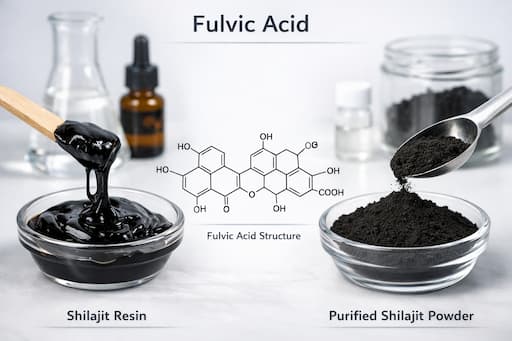
Suggested Image: A clean lab image comparing raw resin vs. refined high-potency powder
The “Dirty” Truth: Heavy Metals & Safety Compliance
This is the most critical section for your compliance team.
Shilajit is essentially compressed organic matter from centuries of decomposition sandwiched between rocks. By nature, raw Shilajit is often contaminated with lead, arsenic, mercury, and cadmium.
If you buy cheap Shilajit, you are likely buying heavy metals.
Our Purification Process
To make Shilajit extract safe for dietary supplements (meeting FDA and Prop 65 standards), it must undergo rigorous purification.
- Solvent Extraction: We use water and ethanol to separate the bioactive fulvic acid from the rock impurities.
- Filtration: Removing soil, grit, and insoluble heavy metals.
- Vacuum Drying: Creating a fine, flowable powder without degrading the heat-sensitive compounds.
[Internal Link: View Our Factory’s Quality Control & Heavy Metal Testing Protocols]
Formulating Success: Applications & Blends
As an R&D professional, you need ingredients that play well with others. Shilajit extract powder is water-soluble and relatively stable, but it has a distinct earthy taste. Here is how we see our B2B partners successfully utilizing it:
1. The “Male Optimization” Stack
- Concept: Natural hormonal support and drive.
- The Blend: Shilajit Extract (50% Fulvic Acid) + Tongkat Ali (200:1) + Zinc + Boron.
- Why it works: Clinical studies suggest Shilajit supports healthy testosterone levels already within a normal range [1].
2. The “Cellular Energy” Pre-Workout
- Concept: Stim-free energy focused on mitochondrial function.
- The Blend: Shilajit + CoQ10 + PQQ.
- Why it works: CoQ10 helps mitochondria generate ATP, while Shilajit (Fulvic Acid) enhances the stability and absorption of CoQ10 [2].
3. Nootropic Focus Capsules
- Concept: Mental clarity and brain fog reduction.
- The Blend: Shilajit + Lion’s Mane Mushroom + Bacopa Monnieri.
How to Spot “Fake” Shilajit (A Buyer’s Checklist)
The market is flooded with products that are essentially humic acid from soil (fertilizer grade) labeled as Himalayan Shilajit. Here is how to protect your brand reputation:
| Test Parameter | Genuine Shilajit Extract | Fake/Adulterated Product |
| Smell | Distinctive earthy, tar-like, slightly smoky odor. | Smell-less or smells like chemical burnt rubber. |
| Taste | Bitter, astringent, complex. | Salty or sugary (fillers added). |
| Solubility | Dissolves completely in water without residue. | Leaves sandy sediment or clumps. |
| Dibenzo-alpha-pyrones | Present (Key bioactive marker). | Absent. |
| Origin | High altitude (Himalayas/Altai). | Low altitude soil extraction. |
At Aiherba, we provide full traceability from the Himalayan source to the final extracted powder.
Technical Specs & Manufacturing FAQ
We know you have specific questions before you request a sample. Here are the answers from our technical team.
Q: What is the recommended dosage for Shilajit Extract?
A: Most clinical studies utilize a dosage between 250mg and 500mg per day of a purified extract (containing at least 50% fulvic acid).
Q: Is your Shilajit Extract water-soluble?
A: Yes, our spray-dried powder is highly water-soluble, making it suitable for functional beverages, powdered stick packs, and capsules.
Q: How do you mask the taste in liquid formulations?
A: The taste is strong. For powders and liquids, we recommend pairing it with strong flavor profiles like cocoa, coffee, or berry blends with high-intensity sweeteners (Stevia/Monk Fruit).
Q: Do you offer Private Label or OEM services?
A: Yes. We are not just an ingredient supplier; we are a manufacturing partner. We can blend, encapsulate, and package your Shilajit product in our GMP-certified facility.
Conclusion: Sourcing for the Long Term
The Shilajit trend isn’t slowing down, but regulatory scrutiny is heating up. Brands that cut corners on sourcing will face recalls or consumer backlash due to heavy metal contamination.
Don’t risk your brand’s reputation. Partner with a manufacturer that prioritizes safety, standardization, and science.
Ready to develop your next best-seller?
Get our complete technical data sheet (TDS) and a competitive quote today.
[CTA Button: Request A Quote & Free Sample]
(Link to Inquiry Form – Not Add to Cart)
References & Scientific Citations
To ensure the accuracy of this article, we have referenced the following peer-reviewed studies and regulatory guidelines:
- Testosterone Support: Pandit, S., et al. (2016). Clinical evaluation of purified Shilajit on testosterone levels in healthy volunteers. Andrologia. (Available at PubMed).
- Energy & CoQ10: Bhattacharyya, S., et al. (2009). Shilajit dibenzo-alpha-pyrones: Mitochondria-targeted antioxidants. Pharmacologyonline.
- Cognitive Health: Carrasco-Gallardo, C., et al. (2012). Shilajit: A Natural Phytocomplex with Potential Procognitive Activity. International Journal of Alzheimer’s Disease. (Available at NIH).
- Safety Guidelines: FDA. Dietary Supplements: New Dietary Ingredient Notifications and Related Information.
